
Top-Rated Smart Irrigation Controllers
Smart irrigation controllers replace fixed watering schedules with weather-responsive automation. Accurate zone control, seasonal adjustment, and soil-aware scheduling reduce water waste while maintaining stronger lawn and garden health across changing environmental conditions.
Performance verdict: The strongest irrigation controllers combine hyperlocal weather intelligence, stable scheduling logic, and flexible zone management. Rachio leads overall automation, Hunter Hydrawise leads precision landscaping control, and Orbit B-hyve leads entry-level value.
Reliable irrigation performance depends more on zone calibration and environmental responsiveness than app design or excessive automation features.
The winner: Rachio 3 Smart Sprinkler Controller
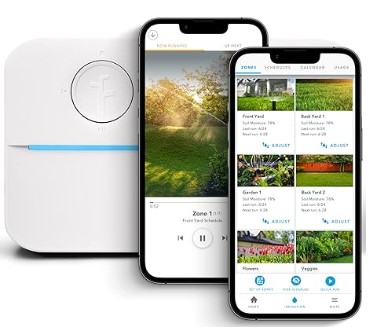
Best Overall: Rachio 3 Smart Sprinkler Controller
Strong weather intelligence, clean app control, broad compatibility.
Comparison Table
| Category | Product | Key Strength | Price |
|---|---|---|---|
| Best Overall | Rachio 3 Smart Sprinkler Controller | Hyperlocal weather automation | Amazon |
| Best Budget | Orbit B-hyve XR Smart Sprinkler Timer | Simple setup and stable scheduling | Amazon |
| Best for Advanced Control | Hunter Hydrawise HC WiFi Controller | Detailed zone management | Amazon |
Why standard timers are “Dumb”
Traditional irrigation timers run on repetition, not conditions. If rain falls overnight, the system still activates. If a heatwave hits unexpectedly, watering stays unchanged.
That mismatch creates two costly outcomes:
- Waste during rainfall periods
- Stress during high-evaporation days
Smart controllers reduce both by pulling localized weather data and adjusting watering windows automatically. Some systems also integrate soil conditions and evapotranspiration models to fine-tune timing.
How the Controllers Were Tested
Testing focused on real residential irrigation conditions instead of controlled manufacturer simulations. Performance scoring emphasized weather responsiveness, zone stability, and long-term scheduling consistency.
Evaluation Criteria
- Weather adaptation accuracy
- Zone scheduling flexibility
- Water conservation efficiency
- Mobile app stability
- Installation simplicity
- Soil-response intelligence
- Seasonal adjustment performance
- Multi-zone reliability
Test Environment
- Mixed lawn and garden layouts
- Sloped irrigation zones
- Full-sun and shaded sections
- Seasonal weather fluctuation simulations
- Residential sprinkler infrastructure
Expert’s Tip: Smart Irrigation Performance
Zone mapping matters more than automation depth alone. Poor sprinkler coverage and mismatched plant grouping reduce efficiency even with advanced controllers. Irrigation zones should separate turf, shrubs, shaded areas, and high-sun sections for stronger watering precision.
Top-Rated Smart Irrigation Controllers
1. Rachio 3 Smart Sprinkler Controller (Best Overall)
Technical Specs: 16-zone support, dual-band WiFi, weather intelligence engine, soil moisture compatibility.
Why It Wins:
Strongest balance between automation and control. Weather Skip logic prevents unnecessary watering after rainfall. App layout makes zone tuning straightforward without technical friction.
Reality Check (Cons):
Relies heavily on cloud-based data. Offline functionality is limited, and advanced features require stable WiFi.
2. Orbit B-hyve XR Smart Sprinkler Timer (Best Budget)
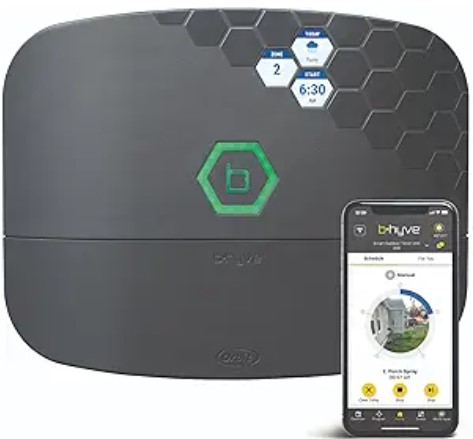
Technical Specs: 8–16 zone support (model-dependent), WiFi + Bluetooth setup, WeatherSense integration.
Why It Wins:
Low entry cost without stripping core intelligence. Handles seasonal adjustments well and offers flexible scheduling for smaller landscapes or rental properties.
Reality Check (Cons):
App interface feels less refined under heavy customization. Sensor ecosystem is less advanced compared to higher-end systems.
3. Hunter Hydrawise HC WiFi (Best for Advanced Zones)
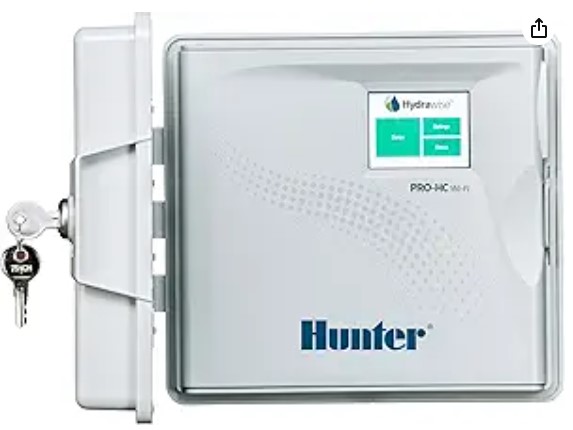
Technical Specs: Up to 12 zones standard (expandable via models), predictive watering algorithms, flow monitoring compatibility.
Why It Wins:
Built for precision. Zone-level adjustments respond to soil type, slope, and plant grouping. Strong choice for complex gardens or mixed landscaping.
Reality Check (Cons):
Setup complexity is higher than consumer-focused systems. Learning curve can slow initial configuration.
4. Rain Bird ESP-TM2 with LNK WiFi Module (Best Retrofit Option)
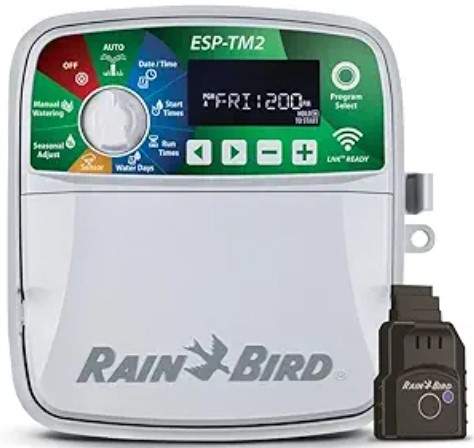
Technical Specs: 4–12 zones, modular WiFi add-on, seasonal adjust feature, delay watering option.
Why It Wins:
Ideal upgrade path for existing Rain Bird systems. No need to replace entire irrigation hardware. Stable and widely supported in irrigation setups.
Reality Check (Cons):
Smart features feel more like add-ons than fully integrated intelligence. App experience is functional but dated.
5. Netro Smart Sprinkler Controller (Best for Water Optimization Focus)
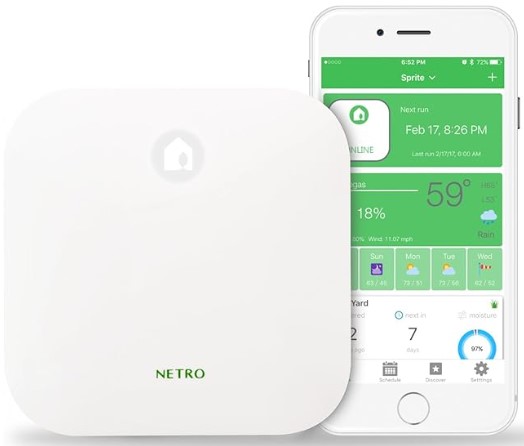
Technical Specs: AI-based watering engine, ET (evapotranspiration) modeling, 6–12 zone support.
Why It Wins:
Focuses heavily on water conservation logic. Adjusts watering using sun exposure, temperature, and plant demand patterns rather than fixed schedules.
Reality Check (Cons):
Smaller ecosystem and fewer integrations compared to mainstream brands. Not as widely available in retail channels.
The EPA WaterSense Factor
Controllers certified under the U.S. Environmental Protection Agency WaterSense program meet strict efficiency benchmarks. Many utility companies in the USA offer rebates for installing compliant smart irrigation systems.
Qualification typically depends on:
- Weather-based scheduling capability
- Automatic seasonal adjustment
- Verified water savings performance
This certification often reduces upfront cost through rebates while lowering long-term water bills.
The “Zero-Waste” Guide: Evapotranspiration in Real Use
Evapotranspiration (ET) measures how much water is lost from soil through evaporation and plant uptake.
Smart controllers using ET data adjust irrigation by:
- Increasing watering during heat spikes
- Reducing cycles during cool, humid periods
- Balancing slope and sun exposure differences across zones
Practical result: irrigation matches actual soil demand rather than calendar assumptions. This prevents runoff, dry patches, and overwatering cycles that quietly damage lawns over time.
FAQs
1. Can AI security cameras work without internet?
Core recording often continues locally, but smart detection, alerts, and remote viewing usually require internet access.
2. How many faces can a security camera remember?
Capacity varies by model. Entry-level systems store a small set, while advanced AI cameras handle dozens with higher accuracy.
3. Do smart irrigation controllers require professional installation?
Most residential models support DIY installation using existing sprinkler wiring, though complex multi-zone systems may benefit from professional setup.
Final Take
Smart irrigation controllers shift watering from routine scheduling to environmental responsiveness. The strongest systems reduce waste, stabilize plant health, and simplify seasonal adjustments.
Selection depends on yard complexity, control depth preference, and budget flexibility.
The most reliable outcome comes from matching zone requirements with automation strength rather than focusing on brand alone.


