
Side-Mount vs Undermount Drawer Slides
Side mount slides suit heavier duty, lower cost, easier replacement needs, while undermount slides suit concealed hardware, cleaner lines, greater drawer width, and premium soft close operation.
Side Mount vs Undermount Drawer Slides
| Product | Primary Strength | Performance | Maintenance | Durability | Price |
|---|---|---|---|---|---|
| Side Mount | Load capacity and simple installation | Strong, predictable travel | Easy access for servicing | Excellent with quality ball bearing construction | Amazon |
| Undermount | Concealed appearance and usable drawer width | Smooth, controlled travel | More specialized adjustment | Excellent with quality hardware | Amazon |
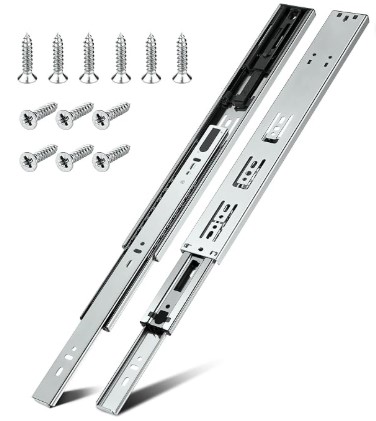
Side Mount: HBL’1 Pair Soft Close Drawer Slides
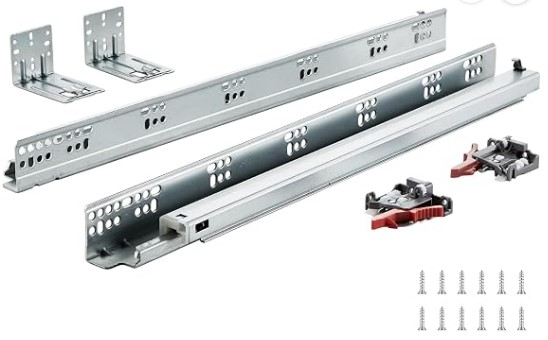
Undermount: VEVOR Bottom Mount Drawer Slides
The Fundamental Difference
The fundamental difference involves where the mechanical support structure sits.
Side mount architecture places the slide mechanism between the drawer side and cabinet wall. Drawer width therefore loses space to slide hardware and required side clearance. A common side mount arrangement needs approximately 1/2 inch per side.
Undermount architecture places the runner underneath the drawer box. Cabinet side clearance becomes much smaller, allowing greater internal drawer width.
The tradeoff shifts toward drawer construction requirements beneath the box. Specific systems can require bottom recesses, rear notches, defined drawer side thickness, and precise mounting positions.
The architectural distinction explains nearly every later difference: appearance, drawer width, installation difficulty, adjustment, and replacement compatibility.
Testing Conditions
A fair comparison uses matching cabinet openings, equal drawer dimensions, equivalent slide lengths, identical drawer loads, and repeated opening and closing cycles.
Performance assessment considers travel smoothness, extension, operating noise, alignment stability, installation complexity, and maintenance access. Load ratings require model specific manufacturer specifications rather than assumptions based solely on mounting style.
Blum TANDEM, for example, offers 100 pound load capacity across a broad range, while other slide families carry substantially different ratings. Accuride catalogs also show major load differences among slide models.
Performance Test
Performance
Side Mount: Strong performance for utility drawers, workshop storage, kitchen drawers, and heavier contents. Ball bearing construction supports substantial load ratings across numerous product families.
Undermount: Smooth operation and excellent stability suit kitchen and furniture cabinetry. Premium concealed systems can support deep and wide drawers with high load capacity.
Speed
Side Mount: Full extension options provide fast access throughout drawer depth.
Undermount: Full extension options provide comparable access, with premium systems adding synchronized movement and controlled travel.
Noise
Side Mount: Ball bearing slides can operate smoothly, although sound varies according to bearing quality, installation accuracy, and drawer load.
Undermount: Soft close systems commonly provide quieter final closing movement. Soft close remains a feature of specific models rather than an automatic consequence of undermount construction.
Reliability
Side Mount: Simple mechanical access and broad product availability make replacement straightforward.
Undermount: High quality concealed systems provide excellent reliability, but drawer dimensions and mounting precision require closer attention.
Maintenance
Side Mount: Visible mounting hardware simplifies inspection and replacement.
Undermount: Concealed construction provides cleaner appearance but requires greater care during adjustment and replacement.
Installation
Side Mount: Installation generally requires accurate side clearance and parallel alignment. Standard side mount ball bearing systems commonly require approximately 1/2 inch per side.
Undermount: Installation demands more drawer preparation. Certain systems require rear notches, bottom recesses, precise drawer thickness, and dedicated mounting hardware. Blum provides templates and assembly devices for precise installation.
Where Side Mount Wins
Side mount slides gain an advantage when load handling, simple installation, or replacement access carries greater importance than concealed appearance.
Heavy utility drawers benefit from the broad selection of side mount ball bearing hardware. Workshop cabinets, garage storage, tool drawers, pantry pullouts, and retrofit projects frequently suit side mount construction.
Replacement projects also favor side mount architecture. Existing drawer boxes commonly already contain side clearance suitable for replacement slides. Changing to an undermount system can require substantial drawer modification.
Budget sensitive cabinetry gains another advantage. Basic side mount slides generally cost less than premium concealed systems, particularly when soft close operation and specialized mounting hardware enter the comparison.
Where Undermount Wins
Undermount slides gain an advantage when appearance, usable drawer width, and refined operation carry greater importance.
Concealed runners remain hidden beneath the drawer box, preserving uninterrupted cabinet lines. Reduced side clearance also permits greater internal drawer width compared with standard side mount arrangements.
Modern kitchens benefit strongly from concealed construction. Premium undermount systems can provide full extension, soft close operation, synchronized movement, and multiple adjustment directions. Blum MOVENTO, for example, provides side, height, depth, and tilt adjustment alongside full extension options.
New cabinet construction also favors undermount systems because drawer dimensions can follow manufacturer specifications from the beginning.
The Hidden Cost
The purchase price represents only one part of drawer slide ownership.
| Ownership Factor | Side Mount | Undermount |
|---|---|---|
| Accessories | Usually minimal | Mounting clips, brackets, or templates may add cost |
| Consumables | Low | Low |
| Installation | Usually simpler | Usually more demanding |
| Maintenance | Straightforward access | More specialized adjustment |
| Replacement | Broad compatibility | Model specific compatibility matters |
| Energy | No meaningful household difference | No meaningful household difference |
| Time | Lower installation time | Higher preparation time |
Which One Fits Your Home?
Choose Side Mount when:
- Heavy drawer loads matter more than concealed hardware.
- Existing drawer boxes already have side mount clearance.
- Replacement simplicity matters.
- Workshop, garage, utility, or storage cabinetry needs durable hardware.
- A lower initial hardware cost matters.
Choose Undermount when:
- Concealed hardware matters.
- Maximum internal drawer width matters.
- Kitchen or furniture cabinetry needs a cleaner appearance.
- Soft close operation matters.
- New drawer construction allows precise manufacturer specified dimensions.
- Multiple front adjustment directions provide useful installation control.
1 Year Ownership Comparison
| Cost | Side Mount | Undermount |
|---|---|---|
| Purchase | Usually lower | Usually higher |
| Consumables | Low | Low |
| Maintenance | Low | Low to moderate |
| Accessories | Usually minimal | Potentially higher |
| Energy | Negligible | Negligible |
| Estimated first year total | Usually lower | Usually higher |
Final Verdict
For households prioritizing load capacity, straightforward installation, replacement ease, and lower hardware cost, side mount slides fit the requirement.
For households prioritizing concealed construction, wider usable drawers, soft close operation, and refined cabinetry, undermount slides fit the requirement.
FAQs
1. Are undermount drawer slides better than side mount slides?
Undermount slides suit concealed cabinetry, wider drawer interiors, and premium operation. Side mount slides suit heavy duty storage, straightforward installation, replacement projects, and lower hardware costs. Neither mounting architecture suits every cabinet.
2. Do undermount drawer slides need more space?
Undermount slides generally need less side clearance than standard side mount slides, increasing usable drawer width. Undermount construction instead requires specific clearance beneath the drawer and may require bottom recesses or rear notches.
3. Can side mount drawer slides replace undermount slides?
Direct replacement normally requires drawer modification because mounting locations and clearance requirements differ.
Existing drawer construction must match the replacement slide specifications before conversion. A side mount replacement generally offers a simpler route when existing side clearance already exists.
To Wrap It Up
Side mount slides prioritize accessible installation, durable load handling, and replacement simplicity; undermount slides prioritize concealed construction, wider interiors, refined movement, and premium cabinet presentation.