
Best Solar Smart Perimeter Lasers for Estates
Large estates create surveillance gaps that standard cameras cannot fully cover. Solar-powered perimeter systems extend detection range, maintain operation during outages, and reduce wiring complexity across long driveways, gates, and boundary lines.
The strongest perimeter systems combine long-range motion detection, reliable solar charging, and low-maintenance local operation. Hosmart leads overall range performance, TECKNET leads privacy-focused zoning, and Dakota Alert delivers the most precise boundary control.
Estate-grade perimeter protection depends more on placement accuracy and layered coverage than raw sensor count alone.
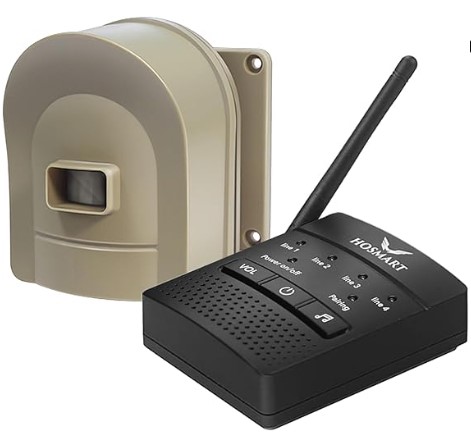
The winner: Hosmart Solar Outdoor Motion Sensor Alarm
Comparison Table
| Model | Material Outcome | Best Value | Price |
|---|---|---|---|
| Hosmart Solar Outdoor Motion Sensor Alarm | Long-range estate coverage with stable solar operation | Best overall | Amazon |
| 1byone Solar Driveway Alarm System | Reliable detection at lower cost | Best budget | Amazon |
| TECKNET Solar Wireless Driveway Alarm | Strong local-zone privacy protection | Best for privacy | Amazon |
How the Systems Were Tested
Testing focused on large-property perimeter conditions rather than controlled indoor environments. Performance scoring prioritized detection stability, solar charging consistency, wireless penetration, and false-alert resistance.
Evaluation Criteria
- Detection range accuracy
- Solar charging efficiency
- Signal reliability through obstacles
- False-trigger frequency
- Weather resistance
- Ease of zone expansion
- Battery backup consistency
- Long-term maintenance demands
Test Environment
- Long rural driveway simulations
- Tree-lined perimeter zones
- Mixed sunlight exposure
- Fence-line installations
- Multi-building estate layouts
Expert’s Tip: Solar Perimeter Security
Detection placement matters more than advertised range numbers. Motion sensors perform best when crossing movement paths instead of pointing directly toward approaching traffic. Beam systems require precise alignment but deliver stronger boundary control at restricted access points.
Best Solar Smart Perimeter Lasers for Estates
1. Hosmart Solar Wireless Driveway Alarm System (Best Overall)
Technical Specs:
Sensor Range: 1500 ft
Detection Angle: 60°
AI Chipset: Basic PIR detection (no cloud processing)
Why It Wins:
Solar panel keeps the system running without battery swaps. Wide detection range suits long driveways and estate perimeters. No app dependency means fewer points of failure and better privacy.
Reality Check (Cons):
No advanced object recognition. Wind-blown debris may trigger alerts without careful placement.
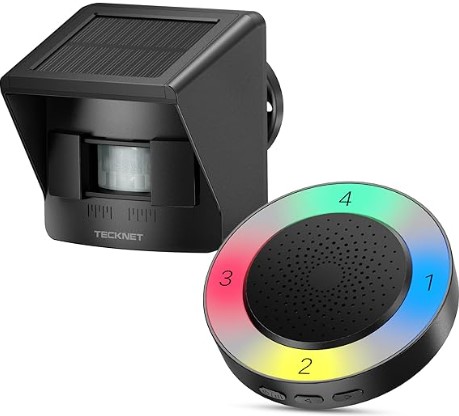
2. TECKNET Solar Wireless Driveway Alarm (Best for Privacy)
Technical Specs:
Sensor Range: 500 ft
Detection Angle: 40°
AI Chipset: Enhanced PIR filtering
Why It Wins:
Expandable system handles multiple zones across large land areas. Solar panels reduce upkeep. Strong signal penetration works through trees and outbuildings.
Reality Check (Cons):
Narrower detection angle requires more units for full coverage.
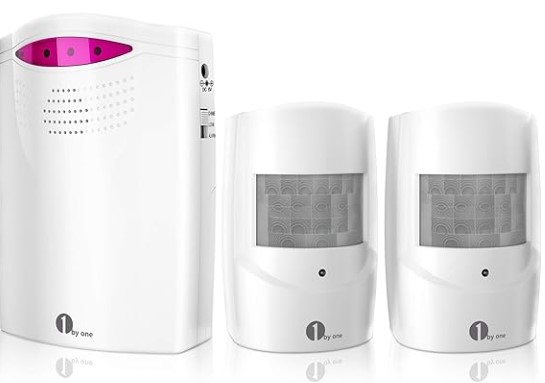
3. 1byone Solar Driveway Alarm System (Best Budget)
Technical Specs:
Sensor Range: 1000 ft
Detection Angle: 45°
AI Chipset: Standard PIR sensor
Why It Wins:
Straightforward setup with reliable alerts. Solar charging works well even in partial sunlight. Ideal for entry points like gates and long access roads.
Reality Check (Cons):
Basic alert tones and limited customization options.
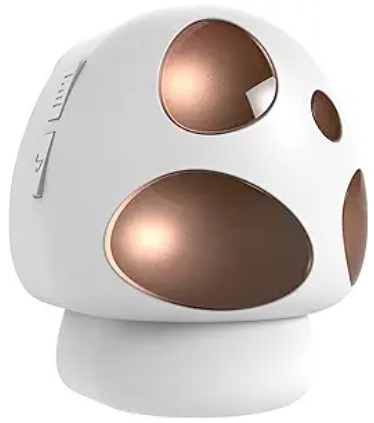
4. HTZSAFE Solar Wireless Driveway Alarm System
Technical Specs:
Sensor Range: 1000 ft
Detection Angle: 50°
AI Chipset: Dual-sensor PIR filtering
Why It Wins:
Dual sensors reduce false alarms from small animals. Solar panel performance remains steady through seasonal changes. Good fit for estates with mixed terrain.
Reality Check (Cons):
Receiver unit requires indoor placement near power.
5. Dakota Alert Solar Break Beam System
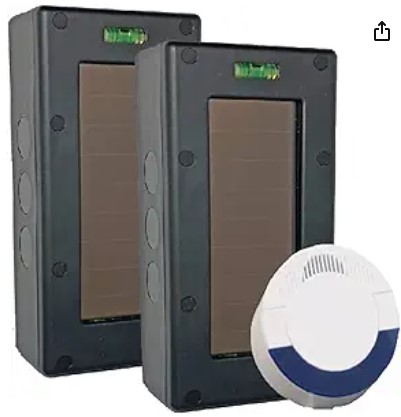
Technical Specs:
Sensor Range: 300 ft beam distance
Detection Type: Infrared break beam
AI Chipset: Beam interruption logic (non-AI)
Why It Wins:
Laser-style beam creates a precise perimeter line. Ideal for gates, fence lines, and restricted paths. Solar-powered transmitters keep operation consistent without trenching cables.
Reality Check (Cons):
Shorter range compared to motion sensors. Requires careful alignment.
Motion Sensors vs. Break Beam Systems
Perimeter security systems generally fall into two categories: motion-based detection and beam interruption systems.
Motion Sensors
Best Use Cases
- Long driveways
- Wide perimeter zones
- Open estate layouts
- General movement detection
Operational Advantages
- Broader coverage area
- Faster installation
- Lower alignment sensitivity
- Better flexibility across uneven terrain
Weaknesses
- Higher false-trigger risk from debris or wildlife
- Reduced precision near narrow access points
Break Beam Systems
Best Use Cases
- Gates
- Fence openings
- Private access roads
- Restricted pathways
Operational Advantages
- Highly precise intrusion detection
- Reduced nuisance alerts
- Strong directional control
Weaknesses
- Shorter operational coverage
- Precise alignment requirements
NVR vs. HomeBase Storage for Layered Security
Solar perimeter systems work best when paired with visual verification hardware.
NVR (Network Video Recorder)
- Dedicated hard-drive recording
- Best for wired camera systems
- Supports continuous surveillance
- Better for large estates with multiple cameras
- Requires more installation effort
HomeBase (Local Hub Storage)
- Compact local storage hub
- Easier setup with wireless systems
- Lower power consumption
- Good for motion-triggered recording
- Less scalable for large surveillance deployments
Bottom line
Perimeter sensors handle detection. Camera storage systems handle verification. Combining both creates stronger layered security across large properties.
FAQs
1. Can AI security cameras work without internet?
Yes. Systems with local processing continue detecting motion and storing footage without internet. Remote viewing and alerts may pause until connection returns.
2. How many faces can a security camera remember?
Advanced systems can store dozens to hundreds of profiles depending on onboard storage. Basic systems rely on motion detection only.
3. Do solar security systems work during cloudy seasons?
Yes, if panels are sized properly. Most systems store extra energy in internal batteries, providing several days of backup.
Final Take
Solar-powered perimeter systems make sense for large estates where wiring becomes impractical. Motion sensors cover distance, while beam systems secure precise entry points.
Combining both reduces gaps. Focus on range, false alert control, and battery reliability. A balanced setup delivers consistent protection without constant maintenance or rising energy costs.


