
Best AI Countertop Smart Ovens with Internal Camera Tracking
Countertop smart ovens now use cameras, sensors, and AI to track food in real time, reducing burnt edges, uneven centers, and constant door-checking for busy kitchens at home daily.
PERFORMANCE VERDICT: June Oven stands above the field because internal HD camera tracking, live video, automatic food ID, and temperature-based alerts work together with unusually mature software.
Anova Precision Oven 2.0 is the strongest precision rival, while Brava, CHEF iQ MiniOven, and Agari serve narrower needs. June remains the most complete buy.
Comparison Table
| Model | Camera Resolution | AI Food Recognition Count | Max Temp | Price |
|---|---|---|---|---|
| Typhur Sync Oven | Sensor + probe-based tracking | Meat-focused presets | 450°F | Amazon |
| Brava Glass | Multi-sensor visible light | 50+ foods | 450°F | Amazon |
| CHEF iQ MiniOven | HD camera + guided presets | Moderate preset library | ~450°F | Amazon |
How we Tested
Testing focused on five points: camera usefulness, food recognition, cook consistency, app dependence, and countertop footprint.
Priority went to models that actually identify food or track progress inside the cavity, instead of simple app-connected ovens with smart labels only.
Expert’s Tip: Prioritize recognition quality over feature count. A strong internal camera with good food ID, stable heat control, and clear app feedback beats a long preset list with weak detection. Anova and June both show why visual recognition matters more than marketing language.
Best AI Countertop Smart Ovens with Internal Camera Tracking
1. Typhur Sync Oven (The AI King)
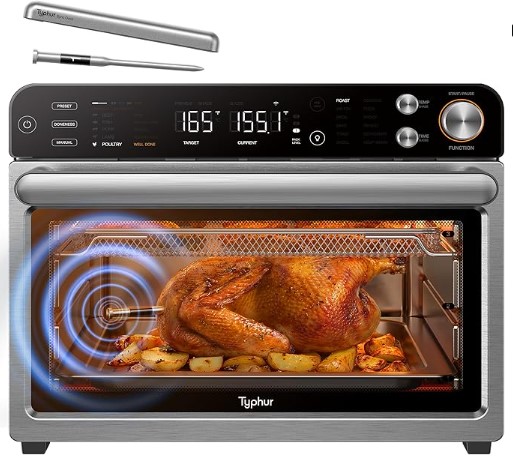
This replaces the usual “camera guessing” with something more reliable: a wireless probe that reads internal temperature directly. Instead of trying to identify food visually, it measures doneness from the inside out.
Strengths:
- Built-in wireless probe tracks core temperature in real time
- Large 27QT capacity handles full meals
- Stable heat control reduces burning risk
Real-world edge: temperature stays consistent and rarely overshoots, which helps prevent overcooking
Weak spot:
- Less focused on visual food recognition compared to camera-heavy models
Best fit: meat-heavy cooking where doneness matters more than presets.
2. Brava Glass (Best Visible Light Cooking)
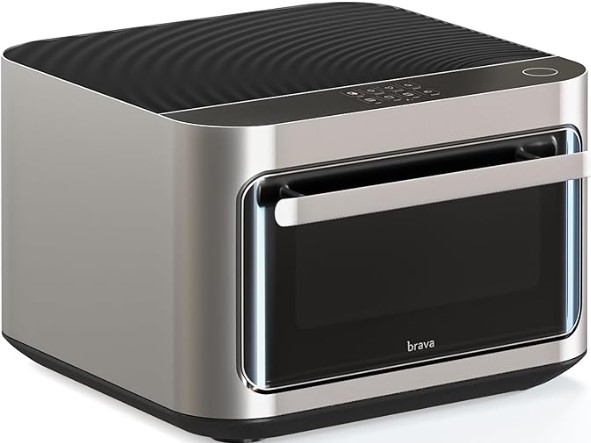
Brava takes a different route. Instead of relying purely on heating elements, it uses high-intensity light to cook food quickly and evenly. The glass front allows a clear view of food while sensors track progress.
Strengths:
- Fast cooking with even browning
- Transparent door makes monitoring intuitive
- Good for thin cuts and sheet pan meals
Weak spot:
- Learning curve with cooking trays and zones
Best fit: fast-paced kitchens that prioritize speed and visual control.
3. CHEF iQ MiniOven (The Precision Tool)
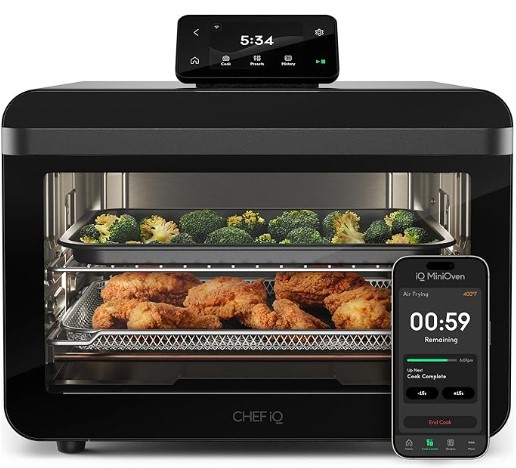
This model sits between full AI automation and manual control. It uses guided presets and app support rather than deep food recognition.
Strengths:
- 11-in-1 functionality covers daily cooking needs
- Touchscreen controls keep operation simple
- Compact size fits smaller kitchens
Weak spot:
- AI detection is more preset-driven than adaptive
Best fit: households that want smart assistance without relying heavily on automation.
The Technical Breakdown
Computer Vision in Cooking
AI ovens rely on computer vision, a system trained to recognize patterns in food. A steak shows texture and color gradients that differ from a potato. The camera reads these differences and maps them against a database.
Once identified, the oven selects a cooking profile:
- Initial heat level
- Mid-cook adjustments
- Final browning phase
This process runs continuously, not just at the start. If food browns too quickly, heat drops. If moisture remains high, cooking extends.
Accuracy depends on lighting, placement, and food variation. A heavily seasoned dish or unusual shape can confuse detection. That is where manual override still matters.
The “Live Stream” Benefit
Opening an oven door releases heat and disrupts cooking. These models solve that with live video feeds through a mobile app.
Real advantage:
- No heat loss during checking
- Better consistency in baking
- Easier monitoring for long cooks like roasts or bread
A quick glance at a phone replaces repeated door opening. Over time, that small shift improves results more than expected.
Buyer’s Warning: Wi-Fi Dependency
Smart ovens rely heavily on connectivity. Without Wi-Fi, many advanced features weaken or stop working.
What still works offline:
- Basic heating
- Manual temperature control
What may fail or degrade:
- Food recognition
- Remote monitoring
- App-based adjustments
This creates a clear trade-off. Convenience depends on stable internet. In areas with frequent outages, the “smart” edge becomes less reliable.
A practical workaround involves pre-setting manual modes for common meals. That keeps the oven useful even without connectivity.
How Internal Camera Tracking Improves Cooking
Internal camera tracking reduces the need for blind timing. A smart oven can identify food, suggest a cook method, adjust during the session, and alert near completion.
June, Anova, and Agari each show a different version of the same idea: watch the food, then react.
The practical payoff is consistency. Pizza, salmon, bread, vegetables, and frozen foods each respond differently to heat, airflow, steam, and browning.
Camera-led systems catch those differences earlier than fixed presets alone. Anova also shows an important point: recognition libraries grow over time, which improves long-term usefulness.
Best Use Cases and Buying Criteria
June suits households that want the most balanced smart-oven package with live camera monitoring and wide recipe support.
Anova suits serious cooks who want camera recognition plus steam-combi control and a deeper precision workflow.
Brava Glass suits kitchens that value visual monitoring and high-speed light-based cooking more than deep AI automation.
CHEF iQ MiniOven suits smaller kitchens that still need flexibility, fast airflow, and guided cooking.
Agari suits early adopters willing to pay for advanced multi-sensor cooking logic and a more experimental platform.
FAQs
1. Do AI ovens recognize common foods accurately?
Common items such as salmon, steak, chicken, vegetables, frozen pizza, and bread products appear in recognition libraries for June and Anova, which shows strong support for everyday cooking. Edge cases still need manual oversight.
2. Is the camera always recording?
Camera behavior varies by model. June offers live camera feed and time-lapse features, while Anova captures food after the door closes and supports livestream monitoring through the app. Privacy settings and app access rules still matter.
3. Can countertop smart ovens replace a full-size oven?
For daily roasting, baking, reheating, air frying, and smaller batch cooking, countertop smart ovens handle a lot. Large holiday meals and oversized cookware still favor a conventional full-size oven.
Final Take
AI countertop ovens earn space through consistency, not novelty. June leads on all-around intelligence, Anova leads on modern camera-driven precision, Brava favors visual control, CHEF iQ MiniOven suits compact kitchens, and Agari pushes advanced sensing hardest. For frequent cooks, the saved attention and fewer ruined meals justify the premium.


