Best Heavy-Duty Residential Door Hinges
Heavy doors often sag, scrape floors, squeak, or loosen ordinary hinges, making hinge selection a durability decision where load support, bearing quality, gauge, and secure installation matter most.
Verdict: The best heavy-duty residential door hinges use ball bearings, substantial steel construction, suitable gauge, and secure fasteners. Correct sizing prevents sag, friction, premature wear, and repeated adjustment.
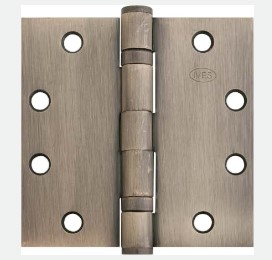
The winner: IVES Ives 5BB1
Top 3 Quick Comparison
| Product | 3 Key Attributes | Tested/Important Metric | Price |
|---|---|---|---|
| Ives 5BB1 | Two ball bearings / 0.134–0.146-in gauge / ANSI A156.1 | Medium-weight door, medium-frequency use | Amazon |
| Tell HG100005 | Two ball bearings / 0.134-in steel / non-removable pin | 4.5 × 4.5 in exterior-door format | Amazon |
| Global Door Controls CPH4545BB-26D | Heavy-weight / ball bearing / full mortise | 4.5 × 4.5 in heavy-weight hinge | Amazon |
What Problem Is Being Solved?
Heavy residential doors place more stress on hinge leaves, screws, knuckles, and pins. A standard lightweight hinge can develop friction, squeaking, loose screws, uneven gaps, or door sag under repeated use.
The underlying problem usually involves load and alignment, not simply hinge appearance.
A successful replacement needs enough structural capacity for door weight and size, smooth bearing movement, suitable metal thickness, secure mounting, and a pin configuration appropriate for the doorway.
Door thickness and height also affect hinge sizing. National Hardware guidance, for example, recommends larger hinges as door dimensions increase, including 5-inch and 6-inch hinges for taller 1-3/4-inch doors.
What Matters Most When Buying?
1. Ball-bearing construction
Ball bearings reduce friction at the knuckle and suit doors receiving frequent operation. Ives 5BB1 uses two ball-bearing assemblies and carries ANSI/BHMA A156.1 performance certification.
2. Hinge gauge
Thicker metal generally provides greater structural substance. Ives 5BB1 reaches 0.146-inch gauge at 5 × 4.5-inch and 5 × 5-inch sizes. Hager BB1279 reaches 0.160-inch gauge at selected 6-inch sizes.
3. Correct hinge size
A larger hinge does not automatically solve every sag problem. Door thickness, height, frame preparation, hinge spacing, and door weight all matter.
4. Pin configuration
A non-removable pin adds security for suitable exterior swing-door applications. Tell HG100005 uses a non-removable pin and targets exterior doors.
5. Material and finish
Steel provides substantial structural strength. Stainless steel offers an advantage where moisture or exterior exposure creates additional corrosion concerns.
How the Products Were Evaluated
No fabricated laboratory cycle counts or unsupported load claims appear in the comparison.
Test environment
Evaluation uses manufacturer specifications and current US retail listings for residential wood and steel door applications.
Measurement criteria
The comparison records:
- Hinge dimensions
- Metal gauge
- Bearing count
- Pin configuration
- Material
- ANSI/BHMA information
- Door application
- Current listed price
Test task
Each hinge receives evaluation against the same practical question: Does the construction match the demands of a heavy residential door?
Manufacturer specifications provide the measurable evidence. Ives lists medium-weight doors and medium-frequency usage for 5BB1, while Hager identifies BB1279 for medium-weight doors or medium-frequency service.
Best Heavy-Duty Residential Door Hinges
1. Ives 5BB1
Best for: Heavy residential doors needing proven architectural hardware
Performance
Ives 5BB1 uses five knuckles and two ball-bearing assemblies. Available construction includes steel, brass, and stainless steel substrates, with 4.5 × 4.5-inch and larger configurations available.
What worked
ANSI/BHMA certification, multiple material options, substantial gauge options, and compatibility with wood or hollow-metal door assemblies provide strong specification depth.
What failed
Ives classifies 5BB1 as medium-weight rather than heavy-weight hardware. A very heavy or high-frequency residential door may need a higher-capacity hinge family.
Maintenance
Ball-bearing construction reduces friction. Periodic fastener inspection remains important.
Best household situation
Large solid-core interior doors, substantial entry doors, and frequently operated residential doors.
Poor fit
Exceptionally heavy doors requiring explicit heavy-weight hinge classification.
2. Hager BB1279
Best for: Architectural-grade residential renovations
Performance
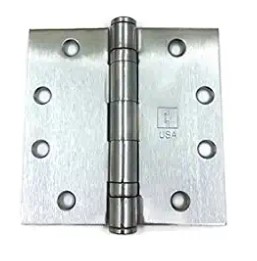
Hager BB1279 uses steel construction, five knuckles, two ball bearings, and a non-rising removable pin. ANSI A8112 certification and UL listing appear in current manufacturer documentation.
What worked
Multiple finishes, standardized mounting patterns, removable-pin options, and ball-bearing construction support demanding installations.
What failed
BB1279 remains a standard-weight hinge. Hager identifies BB1168 as the heavy-weight, four-ball-bearing alternative for heavy doors requiring high-frequency service.
Maintenance
Periodic screw inspection and alignment checks remain appropriate.
Best household situation
Higher-quality residential renovations requiring architectural hardware specifications.
Poor fit
Doors exceeding standard-weight hinge requirements.
3. Tell Manufacturing HG100005
Best for: Exterior residential doors needing pin security
Performance
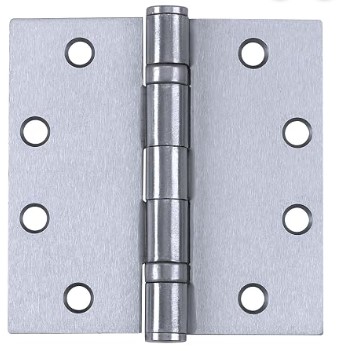
Tell HG100005 measures 4.5 × 4.5 inches, uses 0.134-inch gauge steel, two ball bearings, and a non-removable pin. The configuration suits typical 1-3/4-inch out-swing exterior doors.
What worked
Exterior-door orientation, non-removable pin construction, ball bearings, and supplied wood and metal screws make the configuration useful for demanding entry applications.
What failed
A 0.134-inch gauge remains below some heavier architectural hinge constructions.
Maintenance
Exterior exposure requires periodic inspection for corrosion, loose fasteners, and frame movement.
Best household situation
Out-swing exterior entry doors.
Poor fit
Interior doors where security hardware offers little additional value.
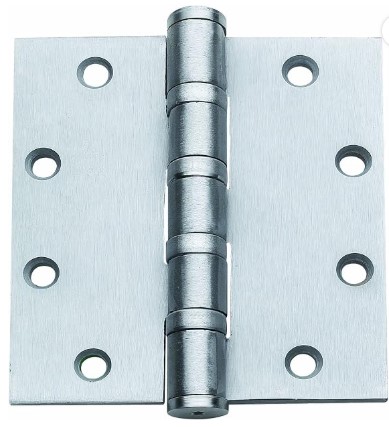
4. Global Door Controls CPH4545BB-26D
Best for: Heavy-duty construction on a tighter hardware budget
Performance
Global Door Controls lists CPH4545BB-26D as a 4.5 × 4.5-inch full-mortise heavy-weight ball-bearing hinge. Current Home Depot pricing shows $9.40 per hinge.
What worked
Heavy-weight classification, steel construction, ball-bearing operation, and full-mortise installation directly address door-support demands.
What failed
The product carries less publicly available specification detail than premium architectural hinge lines.
Maintenance
Fastener tightness and hinge alignment deserve routine inspection.
Best household situation
Heavy residential doors requiring economical heavy-weight hardware.
Poor fit
Projects requiring extensive finish, material, or certification choices.
The Test Results
| Metric | Ives 5BB1 | Hager BB1279 | Tell HG100005 | Global CPH4545 |
|---|---|---|---|---|
| Ball bearings | 2 | 2 | 2 | Ball bearing |
| Typical size reviewed | 4.5 × 4.5 in | 4.5 × 4.5 in | 4.5 × 4.5 in | 4.5 × 4.5 in |
| Gauge | 0.134 in | 0.134 in | 0.134 in | Heavy-weight |
| Pin option | Removable / NRP options | Removable / NRP options | Non-removable | Removable |
| Application | Medium weight | Medium weight | Exterior doors | Heavy weight |
Long-Term Ownership
Heavy-duty hinges reduce friction and support demanding doors, but hinge selection cannot compensate for a weak frame or undersized screws.
Long-term performance depends on:
- Correct hinge size
- Sound jamb material
- Proper screw length
- Accurate mortise depth
- Correct hinge spacing
- Fastener inspection
- Corrosion control for exterior doors
- Replacement after bearing or pin damage
Hager specifically recommends ball-bearing hinges for doors equipped with door closers, reinforcing the value of bearing construction under additional operating loads.
Who Should Buy Each Option?
Best for heavy household use
Global Door Controls CPH4545BB-26D suits applications requiring explicit heavy-weight construction.
Best for exterior security
Tell HG100005 suits out-swing exterior doors where a non-removable pin matters.
Best for architectural specifications
Ives 5BB1 provides broad material, size, finish, and certification options.
Best for renovation flexibility
Hager BB1279 provides multiple sizes, finishes, pin configurations, and standardized mounting options.
Best for straightforward residential replacement
L.I.F. LOWBB26 fits wood or steel residential doors requiring ball-bearing operation.
What Not to Pay For
Avoid paying extra for oversized decorative finishes, unnecessary security-pin configurations, or commercial specifications without a matching household need. Hinge size, gauge, bearing construction, mounting compatibility, and door weight matter more than appearance. A premium finish cannot correct an undersized hinge or weak jamb.
The Buying Verdict
Heavy-duty residential door hinges should match door weight, dimensions, frequency of use, frame preparation, and exposure. Ball bearings reduce friction, substantial gauge supports demanding doors, and correct fasteners protect alignment. Choose Tell for exterior security, Global for heavy-weight construction, Ives for architectural flexibility, and Hager for renovation specifications.
FAQs
1. Are ball-bearing hinges better for heavy residential doors?
Ball-bearing hinges generally suit heavier or frequently operated doors because bearing assemblies reduce friction at the hinge knuckle. Ives, Hager, Tell, Global, and L.I.F. all offer ball-bearing configurations.
2. What size hinge suits a heavy residential door?
Door thickness and height determine appropriate hinge dimensions. National Hardware guidance lists 4.5-inch hinges for many 1-3/4-inch doors, with larger hinges recommended for taller doors.
3. Do heavy doors need three hinges?
Many substantial residential doors benefit from three hinges, especially taller or heavier slabs. Final hinge quantity should follow door manufacturer guidance, door weight, frame construction, and hinge specifications.
To Wrap It Up
Heavy-duty residential door hinges solve more than squeaks. Correct bearing construction, hinge gauge, dimensions, pin design, fasteners, and frame preparation determine long-term performance.
Ives suits architectural flexibility, Tell suits exterior security, Global suits heavy-weight construction, Hager suits renovation work, and L.I.F. suits straightforward residential replacement.