
Swivel vs Fixed Casters for Storage Furniture
Swivel casters suit storage furniture requiring tight turns and flexible positioning, while fixed casters suit straight-line movement and directional stability. Wheel configuration determines maneuverability, tracking, and handling.
Swivel vs Fixed Casters
| Product | Primary strength | Performance | Maintenance | Durability | Price |
|---|---|---|---|---|---|
| Swivel casters | Maneuverability | Turns in multiple directions | Requires swivel and wheel inspection | Depends on bearings, materials, and load rating | Amazon |
| Fixed casters | Straight-line stability | Tracks along a consistent direction | Usually simpler inspection | Depends on wheel construction and mounting quality | Amazon |
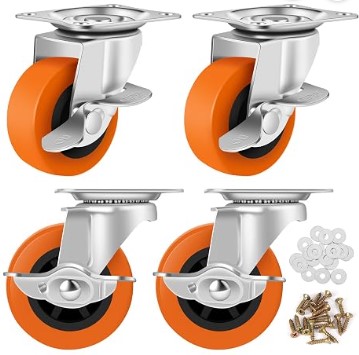
Swivel casters: Bosgeot Heavy Duty Caster with Brake
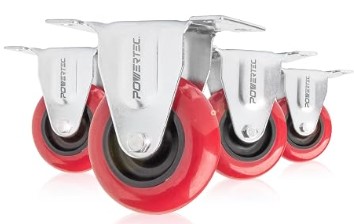
Fixed casters: POWERTEC 3 Inch Fixed Caster Wheels
The Fundamental Difference
The fundamental difference is the direction of wheel movement relative to the furniture frame.
Swivel casters rotate around a vertical mounting axis. The wheel changes direction as the furniture turns, allowing movement around corners and through confined spaces. The swivel mechanism adds a moving joint between the wheel assembly and the furniture.
Fixed casters hold the wheel in one direction. The wheel rolls forward or backward along a defined path, helping storage furniture maintain a predictable travel direction. Changing direction generally requires repositioning the furniture rather than simply turning the wheels.
This structural difference affects everyday handling. A narrow pantry cart moving around kitchen corners benefits from swivel casters. A long storage cabinet moving repeatedly along a straight workshop aisle may benefit from fixed casters.
Neither design automatically provides better load capacity. Wheel material, diameter, bearings, mounting plates, fasteners, and floor conditions determine safe operation.
Testing Conditions
A fair comparison requires matching swivel and fixed casters for wheel diameter, wheel material, rated capacity, and mounting quality. Both configurations should support the same storage unit on the same floor surface.
Movement checks should cover straight travel, cornering, starting effort, stopping, and repositioning under the intended load. Inspect wheel tracking, swivel resistance, mounting movement, and floor marking after repeated trips.
A consistent route and identical loading conditions help isolate differences caused by caster design. Long-term durability requires extended use, so short handling checks cannot establish years of service life. No physical laboratory testing or product-specific measurements are claimed in this comparison.
Performance Test
The following comparison describes typical design behavior rather than invented laboratory results.
Performance
Swivel: Changes direction without lifting or dragging the furniture, making frequent repositioning easier.
Fixed: Maintains a consistent travel direction, particularly useful for long, straight routes.
Speed
Swivel: Supports rapid direction changes but may require initial wheel alignment before straight travel.
Fixed: Rolls predictably along an established path, reducing unnecessary directional correction.
Noise
Swivel: Can produce additional noise when swivel bearings or mounting joints develop looseness.
Fixed: Has fewer directional moving parts, although wheel material and floor texture largely determine rolling noise.
Reliability
Swivel: Adds a swivel joint that requires inspection for looseness, debris, and restricted rotation.
Fixed: Uses a simpler directional assembly, reducing the number of moving joints.
Maintenance
Swivel: Requires checks of wheels, swivel bearings, fasteners, and any locking mechanisms.
Fixed: Requires wheel, axle, fastener, and mounting checks. Routine maintenance is generally straightforward.
Installation
Swivel: Mounting requires adequate clearance for the wheel assembly to rotate without striking cabinet edges or nearby objects.
Fixed: Mounting requires careful alignment so every wheel points along the intended travel direction.
For either configuration, follow the manufacturer’s installation instructions and load limits. Four casters do not always provide a safe working capacity equal to four times the individual wheel rating because uneven floors and load distribution can shift weight between wheels.
Where Swivel Casters Win
Swivel casters offer a clear advantage wherever furniture must change direction frequently.
- Small utility rooms: Turn storage carts between appliances, shelving, and narrow walkways.
- Kitchen storage: Reposition mobile pantry units around counters and dining areas.
- Craft rooms: Move supply cabinets around tables without repeatedly lifting or dragging furniture.
- Flexible home offices: Reposition rolling storage beside desks, printers, or filing areas.
- Frequent access: Bring storage units forward, rotate the working side, and return units to their original positions.
Swivel casters become especially useful when space limits turning radius. However, unrestricted swiveling can make a heavily loaded unit harder to guide along a perfectly straight route.
Where Fixed Casters Win
Fixed casters perform well when predictable directional movement matters more than tight turning.
- Workshop storage: Move tool cabinets along straight aisles.
- Long storage units: Maintain directional control during forward and backward movement.
- Regular transport routes: Reduce unwanted sideways movement along established paths.
- Simpler assemblies: Avoid the additional swivel mechanism and its associated maintenance points.
- Budget-conscious installations: Basic fixed casters often cost less than comparable swivel models.
Fixed casters work best when the route remains relatively straight. A rigid four-fixed-caster arrangement can resist turning and cause wheel scrub, increased pushing effort, or floor marking during sharp turns.
The Hidden Cost
| Cost factor | Swivel casters | Fixed casters |
|---|---|---|
| Accessories | Brakes or locking swivel models may cost extra | Brakes may cost extra |
| Consumables | Usually minimal | Usually minimal |
| Installation | Requires rotational clearance | Requires accurate directional alignment |
| Maintenance | Wheel and swivel-joint inspections | Wheel, axle, and mounting inspections |
| Replacement | Swivel assembly may cost more | Basic assemblies may cost less |
| Energy | None during normal use | None during normal use |
| Time | Saves effort during repeated turns | Saves effort along straight routes |
Swivel casters may reduce handling time in cramped rooms, while fixed casters may simplify repeated travel along predictable paths. Floor damage, difficult turning, premature wheel wear, and unsuitable load ratings can outweigh any initial savings.
Wheel material also matters. Soft rubber or polyurethane wheels may protect suitable hard floors better than hard plastic wheels, but performance varies by compound, floor finish, and load. Confirm floor compatibility before purchasing.
Which One Fits Your Home?
Choose swivel casters when:
- Storage furniture must navigate corners and narrow aisles.
- Frequent repositioning forms part of daily use.
- Furniture needs flexible access from different sides.
- Turning space matters more than strict directional tracking.
Choose fixed casters when:
- Storage furniture travels mainly along straight paths.
- Predictable directional movement is essential.
- A simpler wheel assembly suits the intended use.
- Tight turning is rarely necessary.
Consider a mixed configuration for greater versatility. Two fixed casters and two swivel casters can combine directional tracking with easier steering when mounted in a suitable arrangement.
However, reversing the direction of travel may change handling characteristics. Brakes, caster placement, furniture weight distribution, and the manufacturer’s recommendations remain important.
For stationary storage, locking swivel casters may provide easier positioning and added resistance to movement. A brake does not automatically secure furniture against every slope or heavy pushing force, so verify the brake rating and intended application.
1-Year Ownership Comparison
Without specific products and local prices, a precise monetary comparison would be misleading. The following table outlines typical cost categories for the first year.
| Cost | Swivel casters | Fixed casters |
|---|---|---|
| Purchase | Often moderate to high | Often low to moderate |
| Consumables | Usually negligible | Usually negligible |
| Maintenance | Wheel and swivel checks | Wheel and mounting checks |
| Accessories | Optional brakes or locking features | Optional brakes |
| Energy | $0 | $0 |
| Estimated first-year total | Purchase + installation + repairs | Purchase + installation + repairs |
For an accurate estimate, compare the full set of casters, compatible mounting plates, fasteners, brake options, installation labor, and replacement costs. Include floor protection and handling effort when evaluating long-term value.
Final Verdict
For storage furniture navigating corners and cramped rooms, swivel casters offer easier steering and flexible positioning. For regular straight-line travel, fixed casters provide predictable tracking and simpler construction. Match caster capacity, wheel material, mounting strength, and floor compatibility to the intended furniture load and movement pattern.
FAQs
1. Are swivel casters better than fixed casters for storage cabinets?
Swivel casters suit cabinets requiring frequent turns and flexible positioning. Fixed casters suit cabinets traveling along straight routes. Heavy cabinets also require suitable load ratings, secure mounting, and wheel materials compatible with the floor surface.
2. Can swivel and fixed casters be used together?
Yes. A common arrangement uses two fixed casters and two swivel casters to combine directional tracking with steering flexibility. Correct placement depends on the furniture design, center of gravity, load distribution, and intended travel direction.
3. Which caster type supports heavier storage furniture?
Neither type is inherently stronger. Load capacity depends on wheel construction, bearing quality, mounting hardware, and manufacturer ratings. Select casters rated for the intended load, allowing for uneven weight distribution and real operating conditions.
To Wrap It Up
Swivel casters prioritize maneuverability, while fixed casters prioritize directional control. Select the configuration according to turning space, storage weight, floor type, and movement frequency. Proper load ratings and secure mounting protect furniture and flooring.