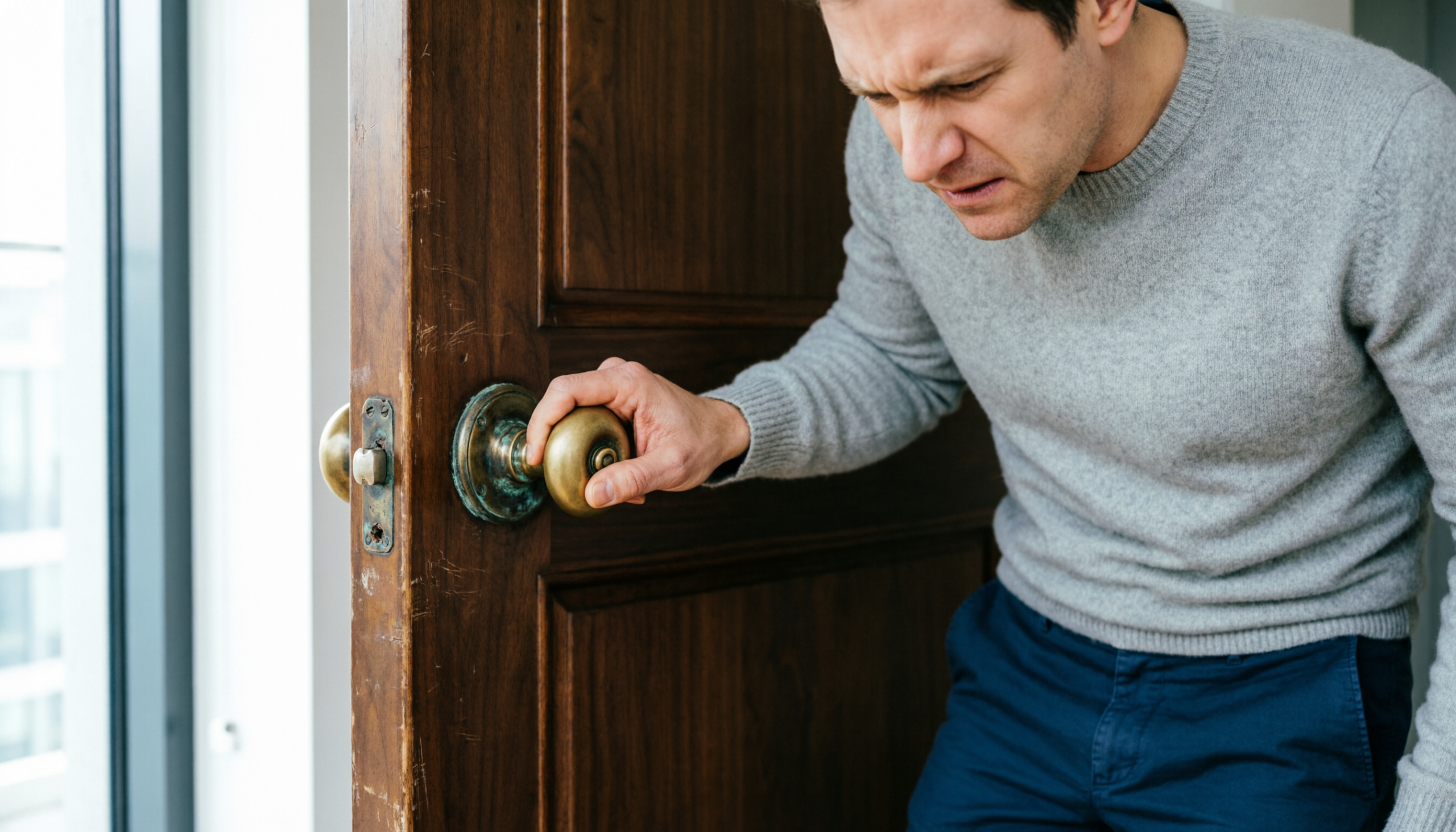
Why Door Handles Become Difficult to Operate Over Time
Verdict: Door handles become difficult to operate because alignment, friction, wear, loose hardware, corrosion, or latch resistance increases over time, making normal handle movement require excessive force.
The Short Answer
Door handles usually become stiff because the handle, spindle, latch, or door no longer moves in proper alignment. Loose screws, swollen doors, corrosion, worn springs, and dry internal mechanisms can increase resistance. Diagnosis starts with separating handle resistance from latch resistance, followed with adjustment, cleaning, lubrication, or hardware replacement.
Why this Problem Happens
Several mechanical and environmental conditions can make door hardware harder to operate.
Cause 1: Door and Latch Misalignment
A door can shift slightly as hinges loosen, frames settle, or seasonal moisture changes door dimensions. Even a small change can place pressure against the latch.
A handle may operate normally while the door remains open but become stiff when the door closes. That pattern strongly suggests latch and strike misalignment.
Cause 2: Loose Mounting Hardware
Handle sets depend on firm mounting. Repeated daily operation gradually loosens screws, especially on frequently used bedroom, bathroom, kitchen, and exterior doors.
Loose mounting allows unnecessary movement around the spindle and handle base. Extra movement increases friction and accelerates wear.
Cause 3: Internal Wear
Springs, return mechanisms, spindles, latches, and bearings experience thousands of operating cycles. Older hardware can develop worn contact surfaces, weakened springs, or increased internal friction.
A handle that no longer returns smoothly after release can indicate internal wear rather than simple surface dirt.
Cause 4: Corrosion and Moisture
Bathrooms, laundry areas, kitchens, coastal homes, and poorly ventilated entryways expose hardware to elevated moisture. Corrosion can increase friction inside moving components and around exposed metal surfaces.
Salt exposure presents an additional problem for exterior hardware near coastal environments.
Cause 5: Dirt, Residue, and Incorrect Lubrication
Dust, cleaning residue, paint, and accumulated grime can interfere with moving components. Heavy household oils can also attract dust and produce sticky deposits.
Incorrect lubrication sometimes masks a mechanical problem rather than solving the underlying cause.
How to Diagnose the Problem
A useful diagnosis separates handle resistance from latch resistance.
Test 1: Operate the Handle With the Door Open
Open the door fully and operate the handle several times.
- Smooth movement indicates possible latch or alignment resistance.
- Stiff movement indicates handle, spindle, spring, or mounting problems.
- Uneven movement suggests wear, contamination, or damaged internal components.
Test 2: Check the Handle Base
Hold the handle firmly and check for excessive movement.
Loose screws, movement at the rose or backplate, or visible gaps indicate mounting problems.
Test 3: Check the Latch
With the door open, press the latch tongue inward several times.
A latch should move smoothly without grinding, sticking, or requiring excessive force.
Test 4: Check Door Alignment
Close the door slowly and observe the latch entering the strike plate.
Contact against the upper, lower, or side edge of the strike opening can indicate alignment problems.
Test 5: Check the Hinges
Inspect hinge screws for looseness. A sagging door can shift the latch position enough to make handle operation difficult.
The Homewardz Test
Open the door and operate the handle ten times. Record any stiffness, grinding, delayed return, or uneven movement. Repeat the test with the door closed. A major difference between both tests points toward latch or alignment resistance.
What Makes the Problem Worse?
Repeated force can damage a weakened handle mechanism, spindle, latch, or mounting point. Overtightened screws can restrict movement. Excessive oil can collect dust.
Aggressive cleaning can damage finishes. Ignored hinge movement can worsen alignment. Moisture and salt exposure can accelerate corrosion on unsuitable hardware.
HOW TO FIX IT
Step 1: Make the Immediate Correction
Tighten loose mounting screws without excessive force. Check hinge screws and correct obvious looseness. Clean visible residue around the handle and latch.
For minor latch friction, use a lubricant suitable for door hardware according to manufacturer guidance. Avoid soaking the mechanism.
Step 2: Correct the Mechanical Cause
Adjust latch and strike alignment when contact occurs during closing. Hinge adjustment may also become necessary when door sag causes latch displacement.
A handle that remains stiff with the door open requires closer inspection of the spindle, spring mechanism, latch, or handle assembly.
Step 3: Address Long-Term Prevention
Select hardware suited to moisture, traffic level, and environmental exposure. Establish periodic checks for loose screws, corrosion, unusual handle movement, and delayed handle return.
Frequent-use doors deserve more regular inspection than low-traffic interior doors.
When a Product Solution Makes Sense
A replacement handle or latch becomes useful when maintenance cannot correct worn springs, damaged spindles, corroded internal components, repeated mounting failure, or poor hardware suitability.
Product selection should follow diagnosis rather than precede diagnosis. A replacement handle cannot correct a sagging door, distorted frame, or persistent hinge problem.
For hardware selection, a dedicated comparison article such as [Best Ergonomic Door Handles for Daily Use] can address handle shape, operating force, grip requirements, mounting design, finish durability, and application suitability.
Preventing the Problem from Returning
Inspect frequently used handles every few months. Check mounting screws, handle return action, latch movement, hinge condition, and visible corrosion.
Early warning signs include:
- Increasing operating force
- Handle movement at the mounting plate
- Slow handle return
- Grinding or squeaking
- Latch contact against the strike
- Visible corrosion
- Door sag
- Increasing difficulty during humid weather
Hardware material also matters. Stainless steel and corrosion-resistant finishes can offer better performance in moisture-prone locations when properly specified.
The Checklist
| Problem | Likely Cause | Test | Correction | Prevention |
|---|---|---|---|---|
| Stiff handle with door open | Internal friction or wear | Operate handle repeatedly | Inspect, clean, lubricate, or replace | Periodic inspection |
| Stiff handle with door closed | Latch misalignment | Compare open and closed operation | Adjust strike or hinges | Monitor door alignment |
| Loose handle | Loose mounting | Check handle movement | Tighten mounting screws | Check screws periodically |
| Handle fails to return | Weak spring or worn mechanism | Release handle and observe return | Repair or replace mechanism | Select durable hardware |
| Grinding movement | Wear, dirt, or corrosion | Slowly operate handle | Clean, lubricate, or replace damaged parts | Control moisture |
| Latch sticks | Dirt or alignment problem | Press latch with door open | Clean or realign | Keep latch area clean |
| Increasing stiffness in humid areas | Moisture-related expansion or corrosion | Compare operation during different conditions | Correct alignment or replace unsuitable hardware | Select suitable materials |
FAQs
1. Why does a door handle become stiff when the door is closed?
A stiff handle that operates normally with the door open often indicates latch pressure or strike misalignment. Hinge movement, door swelling, or frame movement can shift the latch position.
2. Why does a door handle not return to its original position?
A handle that fails to return can have a weakened spring, damaged internal mechanism, excessive friction, or spindle resistance. Continued use can worsen mechanical wear.
3. Should WD-40 or oil be used on a stiff door handle?
General-purpose oils are not always suitable for door hardware. Excessive oil can attract dust and leave residue. Manufacturer-approved lubricant and proper diagnosis offer a more reliable approach.
To wrap it up
Door handle stiffness rarely appears without a mechanical or environmental reason. Alignment, mounting, wear, corrosion, moisture, and contamination provide the main diagnostic categories. Correct diagnosis prevents unnecessary replacement, while routine inspection protects smooth operation and extends the service life of residential door hardware.