
Fixed vs Adjustable Closet Rod Hardware
Fixed closet rods suit permanent layouts and heavy daily use when correctly supported, while adjustable rods suit changing wardrobe needs. Mounting strength and rated load capacity determine dependable performance.
Fixed vs Adjustable Closet Rod Hardware
| Product | Primary strength | Performance | Maintenance | Durability | Price |
|---|---|---|---|---|---|
| Fixed closet rod | Stable, permanent mounting | Consistent when properly supported | Low | High with suitable materials and supports | Amazon |
| Adjustable closet rod | Flexible positioning or width adjustment | Depends on locking mechanism and support design | May require periodic checks | Varies with construction and adjustment mechanism | Amazon |
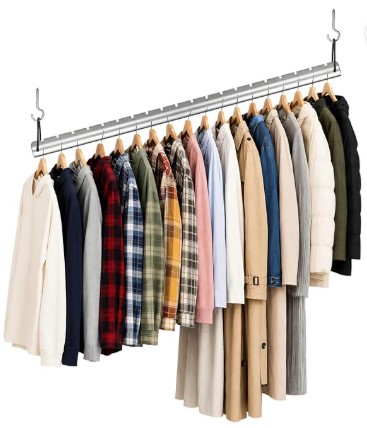
Fixed closet rod: Any Angle Hanging Rail Clothes Rod
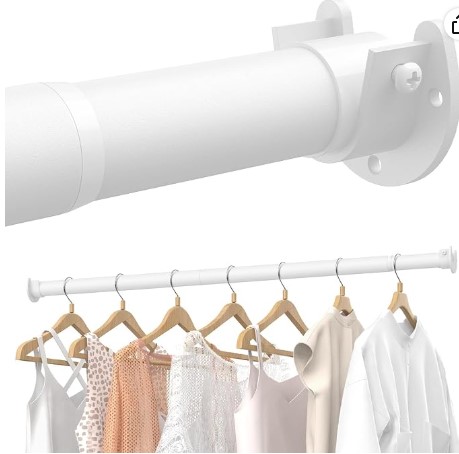
Adjustable closet rod: Closet Rod Heavy Duty, Stepless Adjuatable Closet Pole
The Fundamental Difference
The fundamental difference lies in how each system manages position and structural support.
Fixed closet rod hardware establishes a permanent span between mounting points. Once installed, the rod remains in position unless the brackets are moved or the hardware is replaced.
A properly installed fixed system offers a straightforward load path from the rod through the brackets into suitable structural material.
Adjustable closet rod hardware permits changes to width, height, position, or configuration, depending on the design. Telescoping rods alter span length, while adjustable brackets or track systems permit repositioning.
However, adjustability does not automatically mean greater versatility or lower strength. A telescoping rod with a weak locking mechanism may perform worse than a well-supported fixed rod.
A heavy-duty adjustable system with secure structural mounting may outperform a poorly installed fixed rod.
The key purchasing question is whether the closet requires permanent support or future reconfiguration.
Testing Conditions
A fair comparison evaluates fixed and adjustable hardware under equivalent conditions. Both systems should span the same closet width, support the same intended clothing load, and use compatible mounting surfaces.
Installation should follow manufacturer instructions, including bracket spacing, fastener selection, and stud engagement where required. Performance checks should examine rod deflection, bracket movement, locking stability, and ease of installation. Repeated loading and unloading can reveal looseness or changes in alignment.
Long-term durability requires extended observation, so short-term checks cannot establish years of service life. No physical laboratory test or independently verified product-specific measurements are claimed in this comparison.
Performance Test
The following assessment compares typical design characteristics rather than reporting invented laboratory results.
Performance
Fixed: Offers dependable support when the rod, brackets, fasteners, and mounting surface match the intended load.
Adjustable: Offers similar potential when locking components and supports remain secure. Performance varies more across telescoping and repositionable designs.
Speed
Fixed: Installation may require accurate measuring, cutting, and bracket placement.
Adjustable: Telescoping models can reduce cutting and fitting time. Track systems may require more installation work.
Noise
Fixed: Usually operates quietly because the rod does not need to slide during normal use.
Adjustable: Can develop rattling or movement if telescoping sections, collars, or locking components loosen.
Reliability
Fixed: Has fewer moving components in many designs, reducing opportunities for adjustment-related failure.
Adjustable: Adds flexibility but may introduce locking points, sliding interfaces, or movable joints that require inspection.
Maintenance
Fixed: Usually needs occasional checks for loose brackets, corrosion, or rod deformation.
Adjustable: Requires the same checks, plus inspection of locking mechanisms and adjustment points where applicable.
Installation
Fixed: Requires accurate placement and suitable support at each mounting point.
Adjustable: Can accommodate changing dimensions, but the mounting system must still carry the intended load safely. Adjustment cannot compensate for weak anchors or inadequate wall support.
Where Fixed Closet Rod Hardware Wins
Fixed hardware has the advantage when stability, simplicity, and predictable positioning matter most.
- Permanent wardrobes: Established closet layouts rarely require rod repositioning.
- Heavy clothing loads: Properly specified rods with secure brackets provide reliable support for dense garments, including coats and suits.
- Frequent daily use: Fewer adjustment components reduce potential sources of looseness and rattling.
- Straightforward maintenance: Standard brackets and rods generally require fewer mechanism-specific checks.
- Long-term installations: A well-supported fixed rod avoids paying for adjustment features that may never be used.
The strongest fixed installation still depends on the complete assembly. A thick steel rod attached to weak drywall anchors can fail before a lighter rod secured into suitable structural framing.
Where Adjustable Closet Rod Hardware Wins
Adjustable hardware earns its place when dimensions, storage requirements, or household arrangements may change.
- Growing wardrobes: Adjustable layouts can accommodate changing garment lengths or storage arrangements when the system supports repositioning.
- Rental properties: Removable or repositionable hardware may suit changing occupancy, subject to lease conditions and installation requirements.
- Closet retrofits: Telescoping rods can accommodate certain nonstandard widths without cutting a rod to an exact length.
- Modular storage: Adjustable tracks or brackets can support future layout changes without replacing the entire system.
- Temporary arrangements: Short-term storage projects may benefit from simpler installation and removal.
One important distinction: a tension-mounted adjustable rod is not equivalent to a heavy-duty adjustable system anchored into wall studs or suitable structural supports. Tension-only designs should remain within the manufacturer’s stated load limits.
The Hidden Cost
The initial purchase price rarely tells the complete ownership story.
| Cost factor | Fixed hardware | Adjustable hardware |
|---|---|---|
| Accessories | Standard brackets and suitable fasteners | May require specialized brackets, tracks, or locking parts |
| Consumables | Usually minimal | Usually minimal |
| Installation | Measuring, cutting, and mounting | Adjustment may reduce cutting, but complex tracks can increase labor |
| Maintenance | Occasional fastener and bracket checks | Additional locking-mechanism checks where applicable |
| Replacement | Rod or bracket replacement when damaged | Individual components may be replaceable, depending on design |
| Energy | None during normal use | None during normal use |
| Time | More precision during initial fitting | Potentially faster fitting and easier future reconfiguration |
Which One Fits Your Home?
Choose fixed closet rod hardware when:
- The closet dimensions and storage layout are unlikely to change.
- Heavy garments require a securely supported hanging system.
- Long-term stability matters more than repositioning.
- A simple installation with minimal mechanism maintenance is preferred.
Choose adjustable closet rod hardware when:
- Closet width or configuration may change.
- A modular wardrobe system already supports repositionable components.
- Telescoping adjustment can simplify a difficult fitting.
- Future alterations could otherwise require replacement hardware.
Buying rule: Prioritize rated load capacity, bracket spacing, fastener compatibility, and mounting strength before choosing a finish or adjustment feature.
Manufacturer load ratings may assume specific installation conditions, so check the complete installation requirements rather than relying on the rod material alone.
1-Year Ownership Comparison
The following table outlines likely ownership costs without inventing product prices or unsupported savings.
| Cost | Fixed | Adjustable |
|---|---|---|
| Purchase | Often low to moderate | Often moderate |
| Consumables | Usually negligible | Usually negligible |
| Maintenance | Occasional inspection | Occasional inspection, plus mechanism checks |
| Accessories | Standard brackets and fasteners | May require proprietary components |
| Energy | $0 | $0 |
| Estimated first-year total | Purchase + installation + any repairs | Purchase + installation + any repairs |
For a meaningful numerical estimate, compare actual product prices, local installation rates, required fasteners, and any accessories needed for the selected closet dimensions. Without specific products and prices, a precise monetary total would be misleading.
Final Verdict
For permanent wardrobes and consistently heavy clothing loads, fixed closet rod hardware offers a straightforward solution when structural support matches the load.
For changing layouts, nonstandard spans, or modular storage, adjustable hardware offers greater flexibility. Confirm mounting requirements and rated capacity before comparing prices or finishes.
FAQs
1. Are fixed closet rods stronger than adjustable closet rods?
Not automatically. Fixed rods often have fewer moving components, but strength depends on rod material, diameter, span, bracket spacing, fasteners, and structural mounting.
A properly rated adjustable system can support substantial loads when installed according to manufacturer requirements.
2. Can adjustable closet rods hold heavy winter coats?
Some adjustable systems can support heavy clothing, provided the manufacturer specifies adequate load capacity for the complete assembly.
Check locking strength, maximum span, support placement, and installation requirements. Avoid assuming that a telescoping rod is suitable for heavy loads simply because the rod appears thick.
3. Which closet rod hardware offers better long-term value?
Fixed hardware often offers better value for permanent layouts because of its straightforward construction.
Adjustable hardware can provide better value when future changes would otherwise require new rods, brackets, or installation labor. Compare the complete installed cost rather than purchase price alone.
To Wrap It Up
Fixed closet rod hardware favors stable, permanent storage, while adjustable hardware accommodates changing layouts. Match rated capacity, mounting strength, and installation requirements to household needs before making the final purchase decision.