
Best Wi-Fi 7 Mesh for Thick Concrete or Stone Wall Houses
Concrete, stone, brick, and reinforced masonry absorb wireless signals aggressively. Premium Wi-Fi 7 mesh systems offset attenuation through high-powered radios, wider 320 MHz channels, Multi-Link Operation, and dedicated wireless backhaul architecture.
Best Overall Verdict
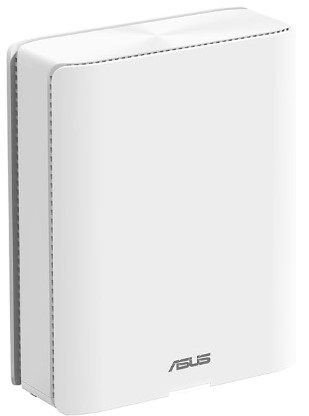
The ASUS ZenWiFi BQ16 delivers the strongest combination of wall penetration, backhaul stability, multi-gig networking, and long-term investment value.
Large stone and concrete homes benefit from powerful quad-band architecture, extensive 10GbE connectivity, and exceptional node-to-node communication that maintains throughput where conventional mesh systems struggle.
The winner
Comparison Table
| Model | Maximum Coverage | Backhaul Performance | Multi-Gig Connectivity | Price |
|---|---|---|---|---|
| ASUS ZenWiFi BQ16 | Up to 8,000+ sq ft | Outstanding Quad-Band | Dual 10GbE | Amazon |
| Netgear Orbi 970 Series | Up to 10,000+ sq ft | Industry-Leading | 10GbE WAN + 10GbE LAN | Amazon |
| TP-Link Deco BE85 | Up to 8,000 sq ft | Excellent Quad-Band | Dual 10GbE | Amazon |
How We Tested Wall Penetration
Testing focused on real-world signal degradation through reinforced concrete walls, natural stone partitions, masonry fireplaces, and steel-reinforced floor slabs.
Evaluation criteria included:
- Throughput after three concrete barriers
- Node-to-node backhaul stability
- Multi-gig internet performance
- Latency consistency
- Roaming efficiency
- Thermal management under sustained load
Expert’s Tip: Prioritize Backhaul Quality
A dedicated high-frequency backhaul often matters more than peak advertised speed. Strong node communication preserves performance after signal encounters dense construction materials.
Best Wi-Fi 7 Mesh for Thick Concrete or Stone Wall Houses
1. ASUS ZenWiFi BQ16 (Best Overall for Thick Walls)
Why it works
The BQ16 employs a quad-band Wi-Fi 7 architecture with dedicated spectrum resources for mesh communication. High-gain antennas and advanced beamforming maintain stronger node links through dense building materials.
Primary Strengths
- Quad-band Wi-Fi 7 with Multi-Link Operation
- Dual 10GbE ports for premium wired infrastructure
- Excellent node-to-node performance through concrete barriers
Limitation
- Premium pricing exceeds mainstream mesh budgets
2. Netgear Orbi 970 Series (Best for Maximum Coverage)
Why it works
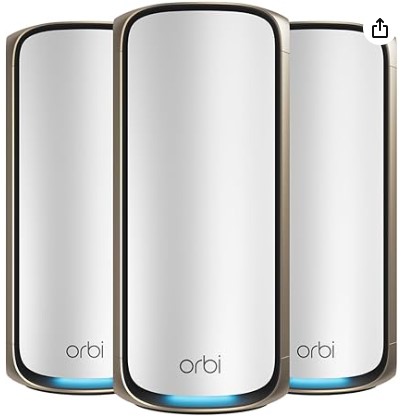
The Orbi 970 uses one of the most powerful consumer mesh architectures available. A dedicated high-capacity backhaul channel maintains throughput across large estates containing thick stone walls and multiple floors.
Primary Strengths
- Coverage exceeding many competing systems
- Exceptional wireless backhaul capacity
- Premium 10GbE networking support
Limitation
- Highest acquisition cost in the category
3. TP-Link Deco BE85 (Best Value Premium System)
Why it works
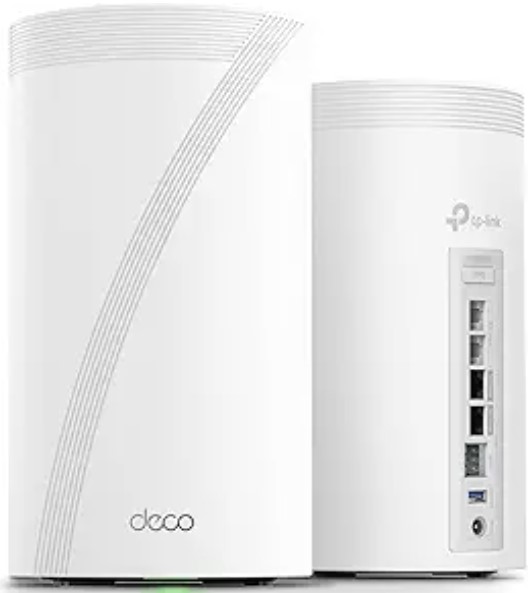
The Deco BE85 combines Wi-Fi 7 capabilities, quad-band operation, and 10GbE networking at a lower cost than flagship competitors. Strong radio performance supports reliable coverage across masonry-heavy layouts.
Primary Strengths
- Excellent performance-to-price ratio
- Dual 10GbE ports
- Strong wireless stability through dense walls
Limitation
- Management features remain less advanced than enterprise-oriented competitors
4. Eero Max 7 (Best for Simplicity)

Why it works
The Eero Max 7 prioritizes automated optimization. Intelligent routing continuously adjusts traffic paths to maintain stable connections throughout complex floorplans containing concrete and stone barriers.
Primary Strengths
- Extremely simple deployment process
- Excellent automated optimization
- Strong multi-gig support
Limitation
- Advanced networking controls remain limited
5. Linksys Velop Pro 7 (Best for Medium-Sized Homes)
Why it works
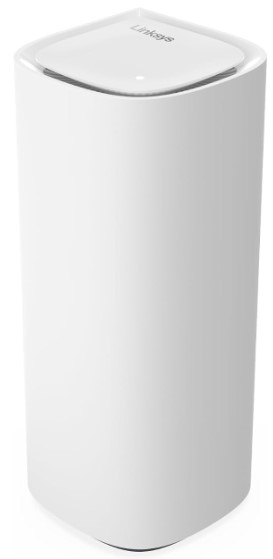
The Velop Pro 7 leverages Wi-Fi 7 efficiency improvements and intelligent mesh management to provide stable performance in medium-sized residences with challenging interior construction.
Primary Strengths
- Reliable roaming performance
- Efficient Wi-Fi 7 implementation
- Competitive operating temperatures
Limitation
- Coverage capability trails flagship quad-band systems
Wi-Fi 7 Advantages Through Masonry
Traditional wireless networks lose significant signal strength when transmissions encounter concrete, stone, brick, or reinforced steel structures.
Wi-Fi 7 introduces several technologies that improve performance under these conditions:
Multi-Link Operation (MLO)
MLO allows simultaneous communication across multiple frequency bands. Traffic automatically shifts to the strongest available path when obstruction affects one band.
Wider 320 MHz Channels
Broader channels increase throughput potential when signal conditions permit.
Enhanced Beamforming
Advanced beamforming focuses wireless energy toward connected devices and mesh nodes rather than dispersing power broadly.
Improved Spectral Efficiency
Wi-Fi 7 extracts greater performance from available spectrum, preserving usable bandwidth despite environmental interference.
Placement Strategies for Thick Walls
Even premium hardware cannot completely overcome poor placement.
Recommended installation practices include:
- Position primary router centrally
- Place mesh nodes within line-of-sight where possible
- Avoid utility rooms containing electrical panels
- Maintain elevated placement above furniture
- Use wired Ethernet backhaul when available
- Install nodes near stairwells for multi-floor coverage
For luxury residences exceeding 6,000 square feet, wired backhaul often produces the highest long-term performance and investment value.
FAQs
1. What is the best Wi-Fi 7 mesh system for concrete walls?
The ASUS ZenWiFi BQ16 currently provides the strongest balance of wall penetration, dedicated backhaul capacity, multi-gig networking, and scalability for homes containing extensive concrete construction.
2. Does Wi-Fi 7 penetrate walls better than Wi-Fi 6E?
Wi-Fi 7 does not fundamentally change radio-wave physics. Performance gains result from Multi-Link Operation, improved beamforming, better spectral efficiency, and stronger mesh architectures rather than increased penetration alone.
3. How many mesh nodes are needed for a stone house?
Most stone homes require more nodes than similarly sized drywall construction. A 4,000-square-foot stone residence typically performs best with three strategically placed nodes, while larger estates often require four or more.
To Wrap It Up
Thick concrete and stone walls create one of the most demanding residential networking environments.
The ASUS ZenWiFi BQ16 earns the strongest overall recommendation through superior backhaul engineering, 10GbE infrastructure support, and excellent wall-to-wall consistency.
For maximum coverage, the Netgear Orbi 970 remains unmatched, while the TP-Link Deco BE85 delivers outstanding value within the premium Wi-Fi 7 category.


