Why Cabinet Doors Stop Aligning
Cabinet doors stop aligning when hinges loosen, cabinets shift, moisture changes wood dimensions, or doors carry uneven loads. Hinge wear, poor installation, and repeated force gradually move doors out of position.
The Short Answer
Cabinet doors usually lose alignment because hinge screws loosen, hinge adjustment shifts, cabinet boxes move, or wood changes size with humidity. Repeated opening, heavy doors, overloaded shelves, and uneven installation can accelerate movement.
Alignment problems rarely require replacement. Correct diagnosis usually identifies a loose fastener, hinge setting, cabinet movement, or material change.
Why this Problem Happens
Cause 1: Loose Hinge Screws
Repeated opening and closing gradually stresses hinge screws. Particleboard and fiberboard can lose holding strength when screws repeatedly move inside the same mounting holes.
A loose mounting plate can change the door position by only a few millimeters, yet the change becomes obvious along adjoining doors.
Cause 2: Hinge Adjustment Has Shifted
Modern concealed hinges normally provide several adjustment directions. A small change in the adjustment screw can alter the door’s height, side position, or distance from the cabinet box.
Cleaning, accidental contact, installation work, or repeated adjustment can leave one hinge positioned differently from the others.
Cause 3: Moisture Changes Cabinet Materials
Wood expands and contracts as moisture conditions change. Cabinet doors made from solid wood, veneer, plywood, or composite materials can respond differently to humidity.
Seasonal humidity changes can therefore produce uneven gaps, rubbing edges, or doors that no longer sit flush.
Cause 4: Cabinet Boxes Move
A cabinet box does not remain perfectly rigid when wall fastening, flooring, adjacent cabinets, or cabinet joints shift. Small movement can change the relationship between the door and cabinet opening.
A door can remain correctly adjusted while the cabinet structure itself moves out of square.
Cause 5: Uneven Load and Daily Force
Heavy doors place greater demand on hinges and mounting points. Frequent slamming, pulling on door edges, or using a cabinet door as a handhold adds unnecessary force.
Large pantry doors and tall doors can show alignment problems sooner because greater door weight increases hinge loading.
How to Diagnose the Problem
Start with the door rather than immediately adjusting every hinge.
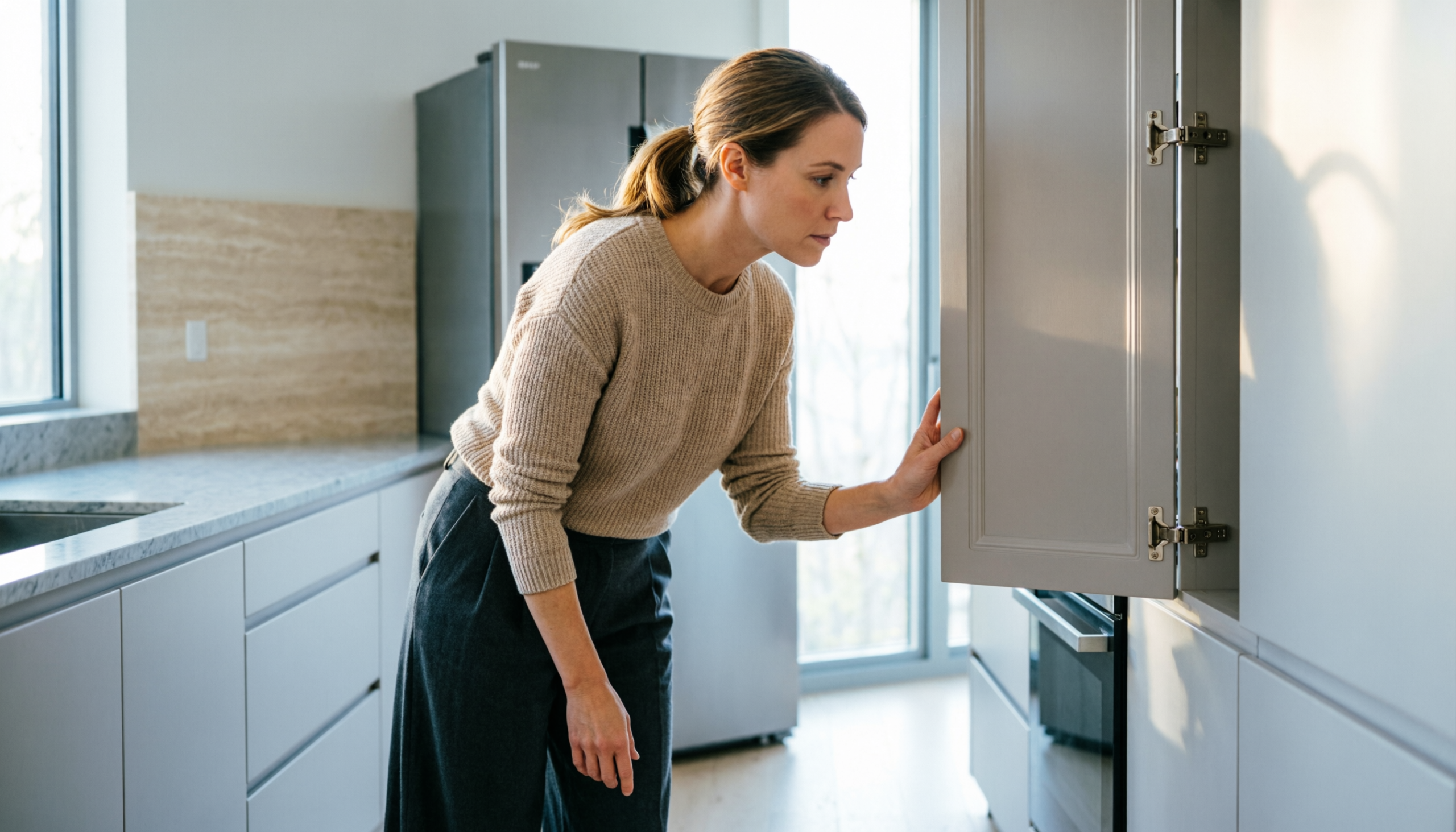
Check alignment: Compare the gap around the door with neighboring doors. An uneven top, bottom, or side gap provides a useful clue.
Check hinge screws: Open the door and inspect every mounting screw. Tighten loose screws carefully without stripping the material.
Check operating force: Open and close the door slowly. Resistance, rubbing, or sudden movement can indicate structural or hinge problems.
Check hinge wear: Look for loose hinge arms, damaged mounting plates, bent components, or excessive movement.
Check installation: Place a straightedge across adjoining cabinet fronts. A noticeable change can indicate cabinet movement rather than simple hinge misalignment.
Check load: Remove unusually heavy items from nearby shelves and observe whether door movement changes.
A crucial distinction matters: one misaligned door usually points toward hinge or mounting problems; several neighboring doors moving together can indicate cabinet movement or environmental change.
The Homewardz Test
Close the affected cabinet door gently and measure the gaps at the top, middle, and bottom with a ruler. Record measurements, then repeat after 24 hours. A changing pattern suggests movement, while a stable uneven gap points toward adjustment or installation.
What Makes the Problem Worse?
Overtightening screws can damage mounting material. Reusing stripped holes weakens hinge attachment. Adjusting every hinge without diagnosis can create new alignment problems.
Excessive moisture, heavy doors, frequent slamming, and overloaded shelves increase stress. Poor cabinet installation can also make repeated hinge adjustment ineffective.
HOW TO FIX IT
Step 1: Immediate Correction
Start with the simplest fault.
- Empty excessive weight from the affected cabinet.
- Tighten loose hinge screws carefully.
- Check mounting plates for movement.
- Adjust hinge height, side position, and depth in small increments.
- Close the door after every adjustment.
Avoid turning several adjustment screws repeatedly without checking the result. Small changes can produce surprisingly large movement at the door edge.
Step 2: System Improvement
If alignment returns after adjustment, inspect the underlying condition.
Check stripped screw holes, damaged mounting surfaces, loose cabinet joints, uneven cabinet boxes, and excessive door weight. A weak mounting surface requires reinforcement rather than repeated adjustment.
For multiple affected cabinets, inspect cabinet-to-wall fastening and cabinet-to-cabinet connections before adjusting individual doors.
Step 3: Long-Term Prevention
Keep cabinet interiors reasonably balanced. Avoid excessive door weight and unnecessary force. Maintain stable indoor humidity where possible, especially around substantial wood cabinetry.
Check hinge screws during routine household maintenance. Early tightening prevents small movements from becoming major alignment problems.
When a Product Solution Makes Sense
A product solution makes sense when adjustment and maintenance cannot correct the underlying problem.
Replacement hinges may become appropriate when hinge mechanisms wear out, mounting plates become damaged, or existing hinges lack sufficient adjustment range. Reinforcement hardware can help when screw holes no longer hold securely.
A new hinge should match the cabinet construction, door overlay, hinge cup configuration, opening angle, and mounting pattern.
For a product-focused follow-up, link to Best Soft-Closing Cabinet Hinges rather than forcing a replacement into every alignment problem.
Preventing the Problem from Returning
A simple maintenance routine can keep cabinet alignment stable.
- Every 3–6 months: Check hinge screws and mounting plates.
- After cabinet work: Recheck door gaps and hinge settings.
- During humid periods: Watch for rubbing or changing gaps.
- After moving heavy items: Check doors on nearby cabinets.
- Early warning sign: A door begins rubbing, drifting, or requiring extra closing force.
Material selection also matters. Solid wood, plywood, MDF, and particleboard respond differently to moisture, fastener loading, and repeated use. Cabinet construction should match the environment and expected workload.
The Checklist
| Problem | Likely Cause | Test | Correction | Prevention |
|---|---|---|---|---|
| Uneven door gap | Hinge adjustment | Measure top, middle, bottom | Adjust hinges gradually | Check alignment periodically |
| Door sits low | Loose hinge screws | Lift door gently | Tighten or reinforce mounting | Inspect screws |
| Several doors misalign | Cabinet movement | Check adjoining cabinet faces | Inspect cabinet fastening | Maintain secure installation |
| Door rubs after humid weather | Material movement | Compare seasonal gaps | Allow stabilization, then adjust | Control excessive humidity |
| Hinge keeps moving | Weak mounting surface | Test screw holding | Reinforce mounting area | Use suitable fasteners |
FAQs
1. Why do cabinet doors become uneven over time?
Repeated operation gradually stresses hinges and screws. Moisture movement, cabinet settlement, heavy doors, and weakened mounting material can also change door position.
2. Why are cabinet doors suddenly rubbing?
Sudden rubbing can follow humidity changes, loose hinge hardware, cabinet movement, or impact. Several doors rubbing simultaneously suggests a cabinet or environmental issue rather than one defective hinge.
3. Should cabinet hinges be replaced when doors stop aligning?
Not automatically. Hinge adjustment, screw tightening, mounting repair, or cabinet correction may solve the problem. Replacement makes sense when hinge wear, damage, or limited adjustment prevents stable alignment.
To Wrap It Up
Cabinet door alignment depends on hinges, mounting strength, cabinet geometry, material movement, and daily use. Diagnose the source before adjusting hardware. Small hinge corrections solve many problems, while repeated misalignment signals deeper structural or environmental issues requiring proper correction.