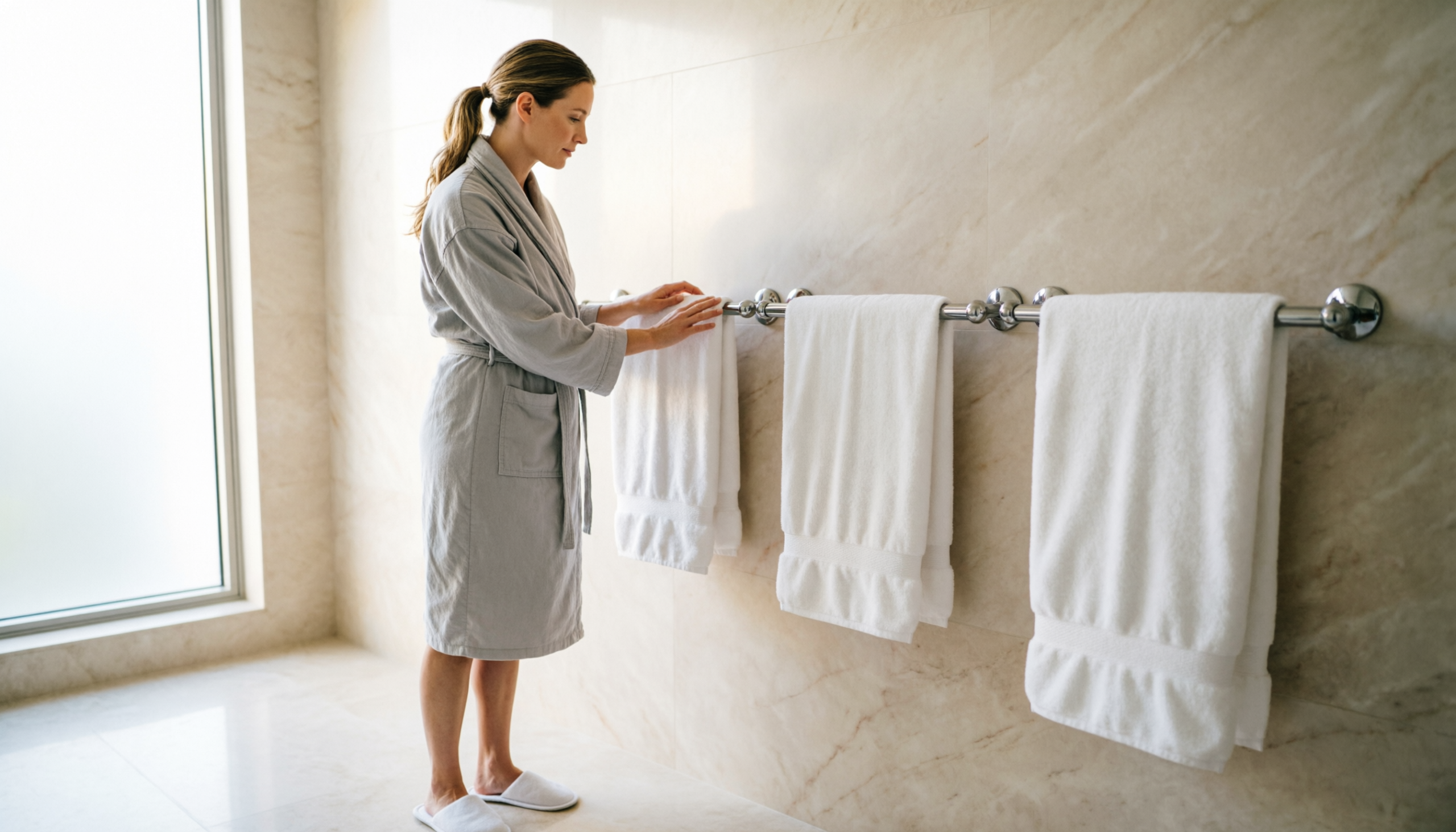
How Bar Spacing Changes Drying Performance
Bar spacing directly affects towel airflow and moisture release. Wider gaps improve ventilation between towels, while tight spacing traps damp air. Correct spacing allows towels to dry faster, reduces musty odors, and improves bathroom hygiene.
The Short Answer
Towel bar spacing affects drying by controlling how much air reaches damp fabric. Closely packed towels overlap, restrict evaporation, and remain wet longer.
Adequate separation exposes more fabric to moving air. For most bathrooms, leave enough room for each towel to hang freely without touching adjacent towels or walls.
Why This Problem Happens
Slow towel drying rarely comes from one cause alone. Bar spacing influences airflow, but towel thickness, humidity, and ventilation also determine drying speed.
Cause 1: Insufficient Space Between Bars
Parallel towel bars positioned too closely together can cause hanging towels to overlap. Overlapping fabric reduces the exposed surface area available for evaporation.
Hardware principle: More exposed fabric generally supports faster drying when temperature, humidity, and airflow remain similar.
Cause 2: Restricted Air Circulation
Towels release moisture into surrounding air. Without adequate air movement, humid air collects around the fabric and slows further evaporation.
A narrow gap between bars can restrict circulation, especially when thick bath sheets hang from both rails. An exhaust fan or open window can improve air exchange, although external humidity and outdoor conditions affect the result.
Cause 3: Thick Towels and Deep Folds
Heavy cotton towels retain more moisture than lightweight hand towels. Folding a large bath sheet over a short rail doubles the fabric layers and slows drying through the thicker section.
Even generous bar spacing cannot fully compensate for several dense fabric layers hanging together.
Cause 4: Excessive Bathroom Humidity
Bathrooms with poor extraction, frequent hot showers, or limited natural ventilation often maintain elevated humidity. Damp air reduces the difference between the moisture level at the towel surface and the surrounding air, slowing evaporation.
Spacing improvements help, but persistent humidity requires better ventilation.
Cause 5: Poor Bar Placement
A towel bar installed too close to a wall, cabinet, shower enclosure, or another rail can restrict air movement around the fabric.
Incorrect height can also cause towels to touch countertops or floors. These contact points restrict drying and increase exposure to surface moisture and dirt.
How to Diagnose the Problem
A simple inspection can separate spacing problems from ventilation or towel-related problems.
Step 1: Check the gaps.
Hang the usual towels on every rail. Look for overlapping edges, compressed folds, and fabric touching nearby surfaces. Measure the distance between the bars and compare the available hanging space with the actual width of the towels.
Step 2: Check towel thickness.
Compare a lightweight hand towel with a thick bath towel under similar conditions. If the lighter towel dries substantially faster, fabric density and retained moisture may contribute to the problem.
Step 3: Check room ventilation.
Notice whether towels dry more slowly after several consecutive showers. Persistent condensation on mirrors, walls, or windows can indicate inadequate moisture removal, although condensation alone does not identify the exact cause.
Step 4: Check mounting and clearance.
Confirm that the bars remain firmly attached, sit level, and provide enough clearance from walls and fixtures. Loose hardware should be repaired before regular use.
Step 5: Compare drying results.
If towels have sufficient separation but remain damp for unusually long periods, investigate room humidity and air movement before changing the hardware.
The Homewardz Test
Run a simple two-day comparison. Hang similar towels at the same time, using comparable washing and spinning conditions. Keep one towel on an unobstructed rail and another in the usual crowded position. Check both at regular intervals and record the time each takes to become dry. Repeat under similar room conditions.
What Makes the Problem Worse?
Overlapping towels, tightly folded bath sheets, blocked exhaust fans, and crowded bathroom walls all slow moisture release. Poorly positioned rails restrict circulation, while high humidity extends drying time. Avoid judging spacing after one shower alone. Differences in fabric weight, wash-cycle extraction, room temperature, and air movement can distort results.
HOW TO FIX IT
Step 1: Correct the Immediate Problem
Separate overlapping towels and unfold thick bath sheets across the available rail. Hang each towel with the largest practical fabric surface exposed to air.
Avoid stacking damp towels on hooks or folding multiple wet layers over a single short bar.
Step 2: Improve the Hardware Layout
Assess the arrangement of existing rails before adding new hardware.
- Increase separation between parallel bars when towels overlap.
- Position rails away from walls and bulky fixtures.
- Allow enough horizontal space for towels to hang without touching.
- Choose rail lengths that accommodate typical household towels without bunching.
There is no single ideal gap for every installation. A layout suitable for thin hand towels may perform poorly with large bath sheets.
For parallel rails, judge spacing by the depth and movement of the hanging fabric, not merely the distance between the metal bars.
Step 3: Improve Bathroom Ventilation
Run the exhaust fan during showers and afterward according to the manufacturer’s guidance and local ventilation requirements. Clean the fan grille regularly and arrange professional inspection when extraction appears weak.
Where appropriate, improve natural air circulation without allowing outdoor moisture or rain to enter the bathroom.
Step 4: Prevent Recurring Moisture Problems
Hang towels fully after every use. Wash towels regularly, remove excess water efficiently during laundering, and clean ventilation equipment according to its maintenance instructions.
Monitor recurring dampness rather than assuming wider rails will solve every drying problem.
When a Product Solution Makes Sense
Additional hardware becomes useful when the existing layout cannot accommodate household towels without overlap.
Consider a longer towel bar when horizontal space causes bunching. Consider a double towel bar when separate rails can hold towels without restricting airflow. A freestanding towel rack may suit bathrooms where wall space is limited.
Choose hardware according to towel dimensions, mounting strength, corrosion resistance, available clearance, and cleaning access.
For related buying guidance, link this section to a relevant Homewardz article, such as Best Heavy-Duty Towel Bars or Single vs. Double Towel Bars. Product replacement should follow a confirmed space or hardware limitation, not serve as the default response to slow drying.
Preventing the Problem from Returning
A reliable towel-drying arrangement depends on consistent habits and periodic inspection.
- Weekly: Check for loose mounting brackets, crowded rails, and obstructed ventilation grilles.
- Monthly: Inspect rail finishes for corrosion, peeling, or persistent moisture deposits.
- After each use: Spread towels fully rather than leaving thick folds.
- Seasonally: Reassess drying performance when weather or household humidity changes.
- During bathroom changes: Check towel clearance after installing cabinets, shower screens, or other fixtures.
Watch for persistent dampness, musty odors, recurring condensation, and towels that remain wet despite adequate separation. These signs justify checking ventilation and moisture sources before making further hardware changes.
The Checklist
| Problem | Likely cause | Test | Correction | Prevention |
|---|---|---|---|---|
| Towels overlap | Insufficient bar spacing | Hang typical towels together | Separate rails or use a longer bar | Match rail dimensions to towel sizes |
| Thick towels dry slowly | Dense fabric or folded layers | Compare a thick towel with a lightweight towel | Unfold fabric fully | Avoid bunching |
| All towels remain damp | High humidity or poor ventilation | Compare drying conditions after showers | Improve air extraction | Maintain ventilation equipment |
| Towels touch walls | Poor rail placement | Check clearance around hanging fabric | Reposition the rail if feasible | Check clearance during installation |
| Drying varies daily | Changing room conditions | Record humidity and drying times | Address airflow or moisture changes | Monitor seasonal conditions |
FAQs
1. How far apart should bathroom towel bars be?
The correct distance depends on towel size, fabric thickness, and rail arrangement. Measure the hanging depth of typical towels and allow sufficient clearance to prevent overlap. Test the arrangement with fully opened towels before finalizing permanent mounting positions.
2. Do double towel bars dry towels faster than single bars?
Not automatically. Double bars increase hanging capacity, but tightly spaced rails can restrict airflow between thick towels. A double-bar arrangement works best when each towel hangs freely and bathroom ventilation removes moisture effectively.
3. Does towel bar material affect drying performance?
Material has little direct effect on towel evaporation compared with spacing and airflow. However, corrosion-resistant materials such as suitable stainless steel can withstand humid bathroom conditions better than finishes that deteriorate. Durable mounting also helps maintain safe, consistent rail positioning.
To Wrap It Up
Bar spacing changes towel drying by controlling fabric exposure and airflow. Adequate separation helps towels release moisture, but ventilation, humidity, and fabric thickness remain equally important factors. Start with a simple hanging test, correct overlap, and improve air extraction before replacing hardware. A well-planned arrangement supports faster drying and more reliable bathroom hygiene.